



(WXYZ) — Over the past few months, I've done a number of stories on the hyperscale data centers looking to make a home in metro Detroit.
Watch Mike Duffy's video report:
Full coverage: Data centers in Michigan
There are still so many unknowns about data centers, and that causes a lot of fear and confusion, especially when it comes to electricity and your bills.
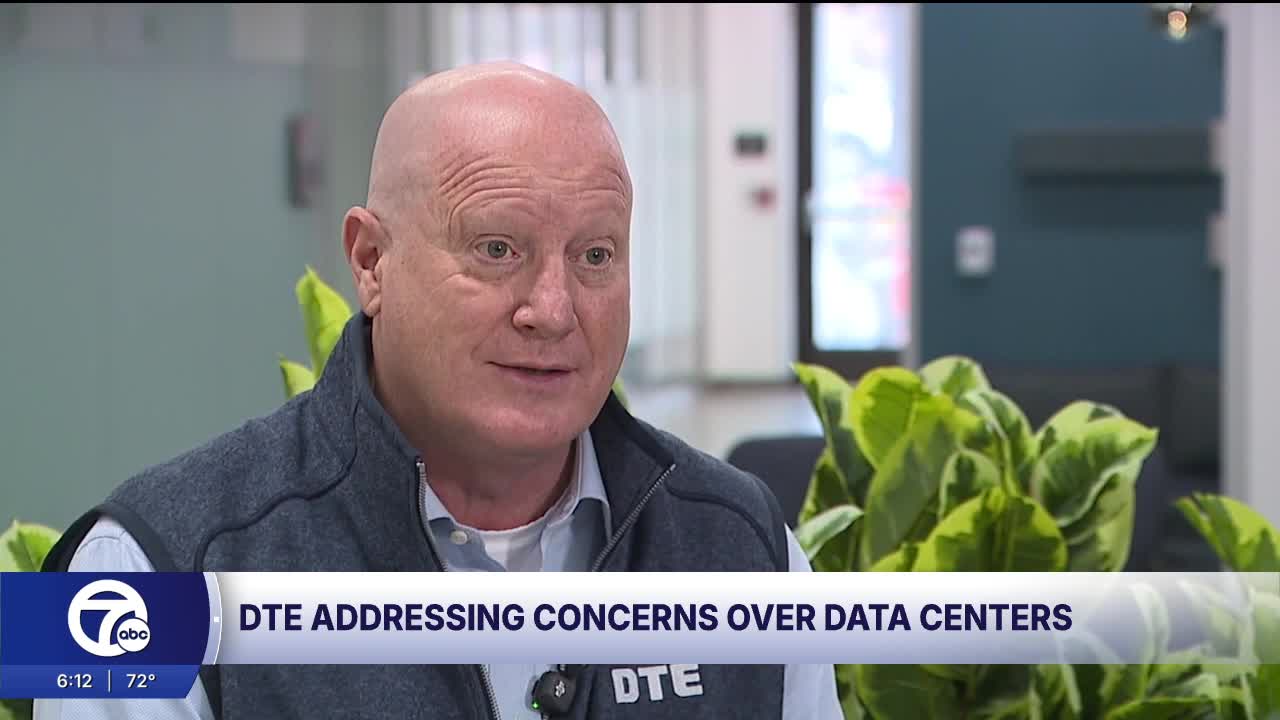
With those unknowns, I took your questions to DTE Vice Chairman Trevor Lauer to learn more.
Extended Interview: DTE Vice Chairman answers questions on data centers
"The main question I get when I’m talking to people is, ‘Will this raise my rates?’ They’re very worried about that. What’s your response to that?" I asked Lauer.
“Yeah, well, I want to be really clear. The answer’s no. So why would I be so clear on why the answer is no? There’s really two things that I would point out to the listeners. No. 1 is the legislature passed laws and said there could be no cross-subsidization. Big Tech has to pay their own way in the state of Michigan. That hasn’t happened in a lot of other states in the United States. So to be really clear, there has been cross-subsidization but that will not happen here in Michigan," he said.
Lauer told me that customers' electric bills have gone up in states where there is deregulation.
Watch below: A look at local data center proposals & why the area is prime for AI development
“The second reason why I say it is the protections that DTE has negotiated in these contracts. When we negotiated these data center contracts, we asked for four provisions that we don’t ask our other customers to sign: a longer contract term, termination fees that they have to pay if they leave early, minimum bills so even if they don’t take electricity off our system, they’re still paying and last a really strong credit and collateral position," Lauder added.
“On a hot summer day, people are already concerned their power won’t be available for that, there will be a kind of an overload on the grid. If we add this extra customer that is obviously a huge consumer of electricity, how can we be sure that won’t be the priority?" I asked.
“In the contracts we’ve negotiated with the data centers, we have the right to turn them down first," Lauer said. “So I think I would just assure everybody that we thought about that as we went into these contracts, that we wanted to make sure that the rest of our customers wouldn’t be impacted. It would be the data centers that would be impacted first.”
"Based on the capacity that we currently have, how many customers do you see as being possible, and would we want to increase that number over time?" I asked.
Watch below: MPSC approves DTE contract for Saline Township data center project
“So we do a lot of modeling here at DTE to understand how much energy we have and how much capacity, because we need both of those to serve the customer. You know, we’re hopeful that we will be able to work through an additional data center contract, or a couple more with customers," he said.
"If we were to bring more data centers online, would we need to generate more power?" I asked.
“Yes, without a doubt. Within Michigan, we need to generate more power," he said.
I also asked about the back-and-forth in December of last year between DTE, the Michigan Public Service Commission and Attorney General Dana Nessel, over contracts to power the Stargate data center project in Saline Township.
"There were a lot of accusations about secret contracts and about speed, process, trying to get these approved. From DTE’s perspective, how did you look at that negotiation?" I asked.
“Well, the State of Michigan was chosen by that customer in a very competitive process to host a data center. What the customer asked us to do was to meet their timeline for construction. So we agreed to file with the Michigan Public Service Commission and ask for an accelerated timeline to meet what our customer needed. I understand what the attorney general said. It would be better to have a 10-month, 12-month process where everybody can hash everything out, but sometimes business doesn’t operate at the same pace that customers, or sometimes the regulatory process doesn’t operate at the same pace that customers need business to move forward with," he said. "So I was disappointed with the way it was framed. There are no secret deals. The MPSC had the opportunity to look at all of the contracts unredacted. They understand everything associated with it. I think sometimes we have to trust that the people in charge of that are doing their jobs and they’re doing them really well."
"What the public saw were a lot of these redacted contracts, which admittedly look suspicious to many people. What would you say about those redactions that they saw?" I asked.
“Well, it was a pretty long contract and it’s easy to pull a couple pages out that are redacted. There were many, many, many. In fact, I would argue 95% of the contract was not redacted. But when a customer asks you to protect their confidential information, we have an obligation to protect their confidential information. And that’s what we did. And we’ve done that for multiple other organizations and companies that are here in Michigan before. Like, it's a pretty standard process," he said.
I think I was just surprised that the attorney general said that even she didn’t get an unredacted copy," I said.
“Yeah, well, the attorney general was not a party to the approval of the case. The ex-parte process that was used, the attorney general was not a party to the case. The commission approved contracts," he said.
“There’s been a lot of hay made of the fact that this data center, when it was coming to Saline Township, a lot of people feel like it was against their will. They initially rejected the data center coming to their area, and then they got sued, and then the data center was coming to their area. But what would you say to people when they consider DTE’s role in that equation?" I asked.
“Well, first I’d say all of the data centers that are trying to get located not only here in Michigan but across the United States need to be very transparent with the communities they’re going into. Talk about who you are. Talk about the benefits of the data centers. Talk about why you chose the location. You know, in that case, we were not actively involved in the Saline process, but I think the more transparent you can be, the better chance you have of locating the facility.”
