

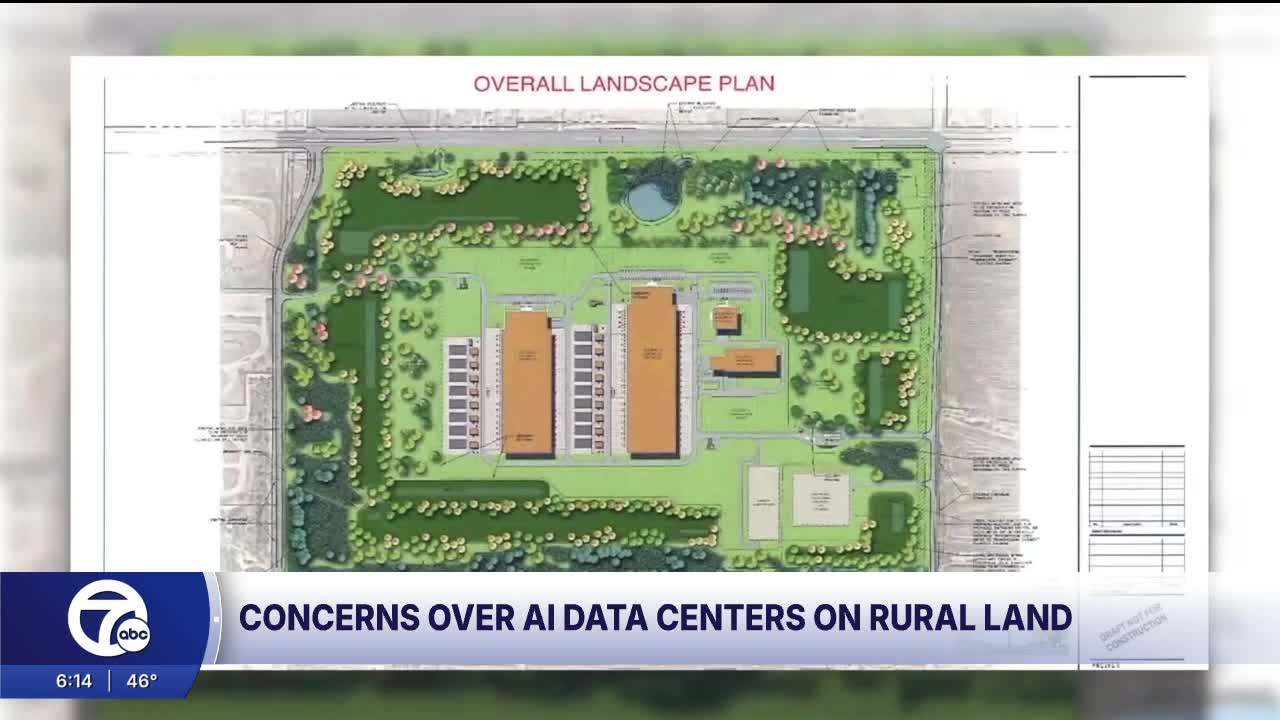



(WXYZ) — Data center proposals continue to pop up across metro Detroit. This leaves both townships and residents scrambling to understand a new reality.
Watch Mike Duffy's video report:
With all of the news around data centers in the area, I wanted to talk to residents, a data center broker and attorneys about how we can navigate this new AI boom.
Sean Webber lives near the proposed data center in Washington Township. He said if the proposal is approved as presented right now, the center would be between the size of three to five football fields of warehouses with computers.
“We were offered less than 48 hours' notice that this rezoning application was going in front of the planning commission," Webber said. "We all had to work very hard, very fast to research the facts, becoming informed and get people involved.”

He thinks the location was chosen for its proximity to major power infrastructure. And while the idled Romeo Ford factory would be a neighbor, Webber said what's on the horizon would be fundamentally different.
"Are our rules and regulations ready for something like an AI data center?" I asked.
“They’re not. We’re putting the cart before the horse here," Kristin Dennison said. She lives near the controversial site of a possible AI data center in Howell. “I know we felt in Howell kind of like our township wasn’t really prepared.”
She’s concerned about construction, traffic and ultimately, noise pollution.
“We really pride ourselves on the rural character, and it just really feels like a massive industrial complex plopped right in the middle of farmland and residential areas would just start to fundamentally change the entire township and the whole county, really," Dennison said.
I wanted to better understand what makes Michigan an attractive place to site AI data centers, so I reached out to Andy Cvengros, the executive managing director and co-lead of the U.S. Data Center Markets team at JLL, a global real estate services firm.
"I’d say the greater Detroit area is highly favored because of the strong power infrastructure. DTE is a phenomenal utility provider. The sales tax exemption programs that are in place that were passed as part of the turn of the year, as well as being highly connected within the overall fiber connectivity across the country, between Chicago, Detroit, to Ashford, Virginia, which is the broader D.C. area, down through the East Coast and New York. It’s a major connectivity point through the country," Cvengros said.
One of the main questions I'm asked by residents who live in rural metro Detroit is: why farmland? Why can't AI data centers be built on former industrial sites? Something our area has in abundance.
“Desire to be in farmland for a lot of these AI centers, the land is generally a lot cheaper than building in industrial or closer to urban areas. Significantly cheaper because you’re able to buy more and build at scale," Cvengros said. "And so it's easy to assemble different farms or different locations and pull together to get you know three to five to a thousand-acre sites as compared to going more of an industrial corridor.
"I’m based in Chicago here, you know, looking at Detroit, you have these very secluded kind of industrial areas which have been traditional manufacturing, generally can’t just get to the size we’d want to in the past. And not all of them are located near the power lines that are highly desired for these types of facilities," Cvengros added.
Pat Lennon is a land-use and zoning attorney and chair of the Honigman zoning and practice group. He's represented numerous high-profile clients around Michigan.
“So the combination of no traffic, and financial benefit, and isolation made me think that these would not be particularly controversial," Lennon said.
He explained that Michigan has already placed its bet when it comes to AI data centers.
“Our state is saying, you know, at the highest levels, through these policies, that these uses are welcome here," Lennon said.
He told me that in his experience, communities are often suspicious about a new land use.
Watch below: Northville City Council unanimously approves 12-month data center moratorium
“In this particular case, though, we’re talking about a very regulated use. You know, it’s not just land use and zoning approvals that need to be obtained for one of these to be established. There are very significant environmental reviews, very significant reviews from the Michigan Public Service Commission, and on and on and on the different regulatory bodies that look at these types of projects," Lennon said.
“There’s always this tension in zoning between property rights and protecting the community," Mark Demorest, a local land-use and zoning attorney, added.
He’s watched local townships trying to navigate an AI data center proposal.
“If a township or city is trying to limit data centers, in terms of future litigation, they’re probably better off regulating it and putting restrictions on it than saying you can’t have it at all," Demorest said.
"What is the danger of saying you can’t have this here at all?" I asked.
“The danger is that the land owner or developer might be able to go to court and say, ‘You’re preventing me from using my land,'" he said.
Watch below: MPSC approves DTE contract for Saline Township data center project
He tells me they do have some tools at their disposal.
“There’s a statute in Michigan called the ‘Right to Farm Act’. And if there’s some farmers nearby, they might have something to say about whether the data center is interfering with their right to farm," Demorest said.
"Would you advise local townships and other municipalities to get ahead of this, to get those on the books now?" I asked.
“I think now or yesterday. Obviously, you can’t modify these retroactively, but the sooner they put something in place, the better. Because if they don’t have any restrictions in place, it may end up that it’s in a place they would prefer it not to be," he said.
Webber said that, as of now, local townships do not have the tools they need.
“I believe it’s time for Michigan’s lawmakers to enter this conversation. We’re going to need legislation from Lansing," he said.
