


(WXYZ) — In today’s Health Alert, amid new measles cases reported in Washtenaw County, doctors are warning about a rare but deadly brain disorder linked to measles. It’s called Subacute Sclerosing Panencephalitis, and it can appear years after someone seems to recover.
We know that measles can cause serious complications. Ear infections, diarrhea, pneumonia, and encephalitis are well-known. But Subacute Sclerosing Panencephalitis, or SSPE, has rarely been seen in the US since measles was declared eliminated in 2000.
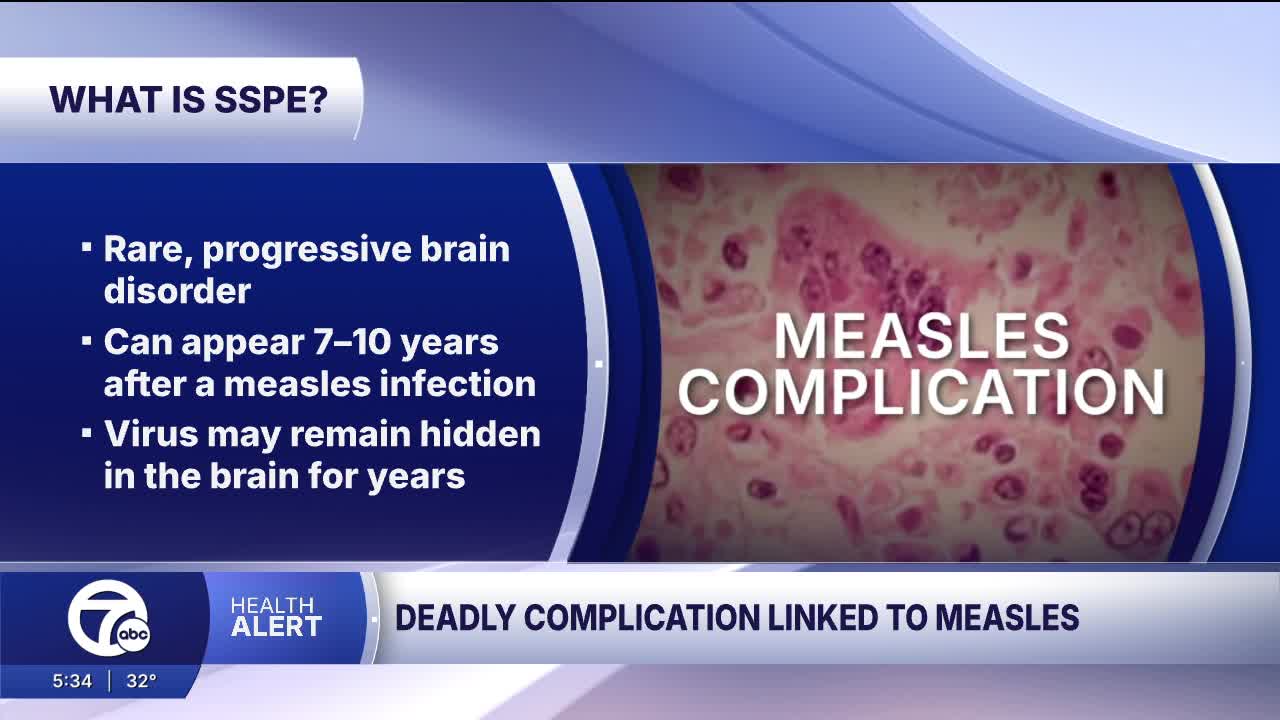
Now, SSPE is a progressive and deadly brain disorder. It may stem from the immune system reacting abnormally to the virus, or to a variant form of it. What’s unusual about SSPE is that it doesn’t show up right away. It usually begins about 7 to 10 years after a measles infection, even if the person fully recovered and seemed completely healthy. Now, why does this happen? Well, researchers think the virus may not completely leave the body and may stay hidden in the brain for years. So far, scientists still don’t fully understand what causes it to become active later.
As for symptoms, they begin gradually. Early signs can include personality changes, mood swings, and depression. As the disease progresses, muscle spasms, jerking, seizures, loss of vision, and dementia can develop. In the final stage, severe brain damage can lead to coma and death.
How many cases are we seeing in the United States, and is there any treatment or a way to prevent it?
Researchers estimate about one in 10,000 people who get measles may develop SSPE. It generally affects children and teens, and tends to affect more males than females. The risk is much higher for children who were infected very young. A 2017 California study found SSPE occurred in about one out of every 1,400 measles cases in children under five, and about one in 600 infected infants.
As for treatment, unfortunately, there is no cure that can reverse SSPE. There are some antiviral and immune-boosting medicines that may slow the disease. But once it begins, people generally die 1 to 3 years after diagnosis.
Now, the concern is that outbreaks in recent years could lead to more SSPE cases down the road. So prevention really matters. The most effective protection against measles is the vaccine. It’s about 97 percent effective after two doses. Getting vaccinated dramatically lowers the risk of measles and the chance of developing SSPE later on. It also helps protect entire communities. That includes babies under 12 months, because the measles vaccine isn’t given until around the first birthday.
