

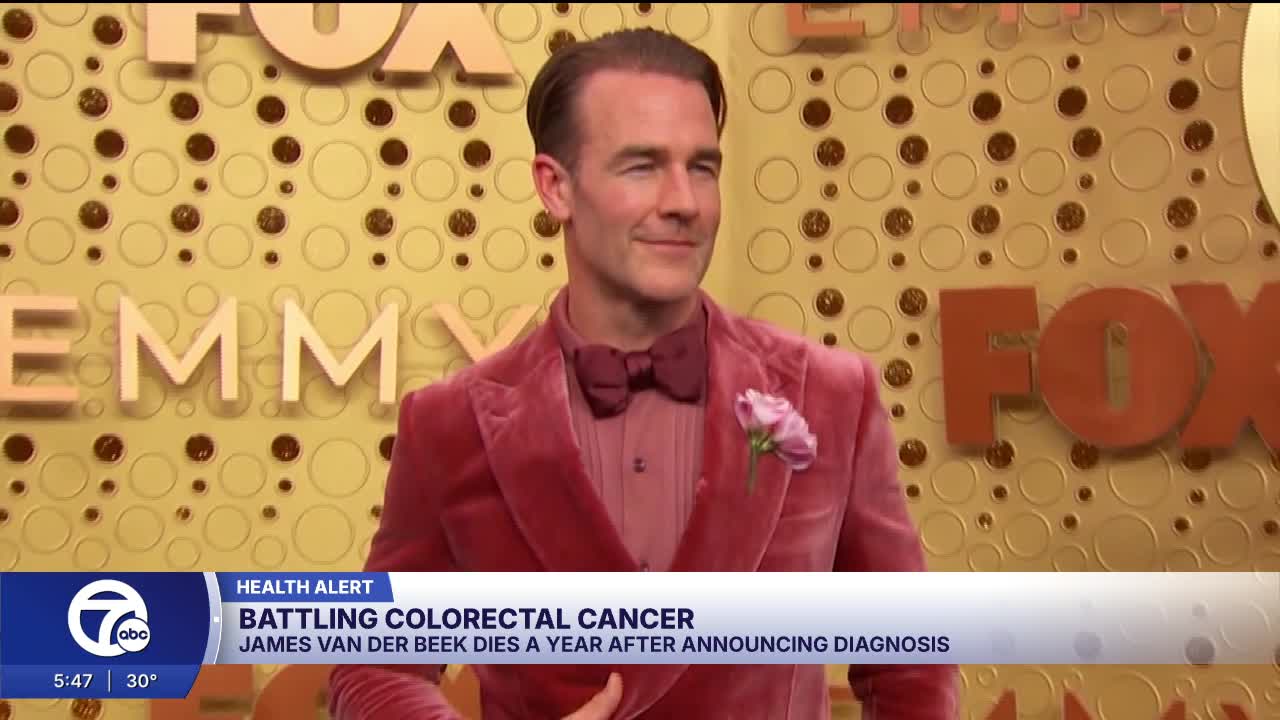


(WXYZ) — In today’s Health Alert, actor James Van Der Beek, best known for the teen drama Dawson’s Creek, has died at age 48 following a battle with colorectal cancer.
My sincere condolences to his family, friends, and, of course, his fans. It’s incredibly sad, and unfortunately, something I see far too often in my practice. James Van Der Beek was diagnosed with stage 3 colorectal cancer at age 46. This was after he noticed changes in his bowel movements. Stage 3 means the cancer has already spread to nearby lymph nodes, and that makes treatment more challenging.
Now, colorectal cancer develops from growths in the colon or rectum, often starting as small polyps. These polyps may not cause symptoms at first, and that’s why screenings are so important. For average-risk adults, the recommended starting age is 45. But for those with a family history, screening may need to begin earlier.
Sadly, colorectal cancer is no longer just an older person’s disease. Diagnoses have steadily increased among adults in their 20s, 30s, and 40s. Deaths have risen as well - for men under 50, it’s now the leading cause of cancer-related death, and for women under 50, it’s the second.
Now, what are the most common warning signs? Well, they include persistent changes in bowel habits, a feeling that you haven’t fully emptied your bowels, blood in the stool or rectal bleeding, ongoing abdominal pain or discomfort, unexplained weight loss, and fatigue. If these issues last more than a few days or happen frequently, it’s important to talk with your doctor right away.
There are tests that can help with diagnosing this. They can include blood tests, fecal tests, imaging scans, and the gold standard, the colonoscopy. That’s where a gastroenterologist like myself examines the colon and may remove tissue or polyps for testing.
Remember, colorectal cancer can develop quietly, but knowing the signs, taking symptoms seriously, and following screening guidance can make a real difference. James Van Der Beek’s story is a reminder of that. He used his own diagnosis to raise awareness about the importance of screening and paying attention to warning signs. So please don’t delay screening or testing - no matter your age.
