

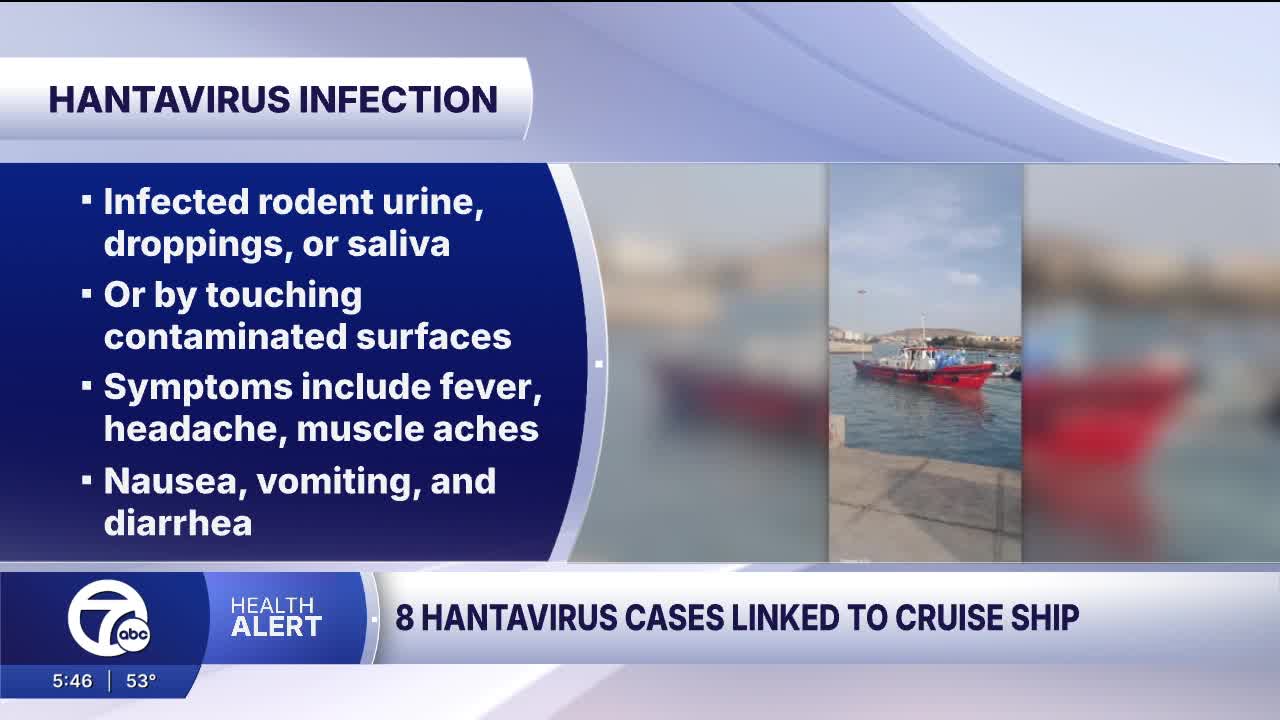


(WXYZ) — In today’s Health Alert, eight cases of hantavirus are now linked to the Dutch cruise ship MV Hondius. The World Health Organization says five hantavirus cases have been confirmed, including two passengers evacuated on Wednesday. Three deaths have been reported.
Laboratory testing has identified the Andes virus - a type of hantavirus.
Hantaviruses can cause serious illness and death. People can get infected through contact with infected rodent urine, droppings, or saliva, or by touching contaminated surfaces.
Symptoms can look like the flu - fever, headache, muscle aches, nausea, vomiting, and diarrhea. But in some cases, they can quickly progress to low blood pressure and sudden, severe breathing problems.
Now, hantavirus has more than 20 viral species. The Andes virus is a rare but serious member of this family. What makes it different is that, in some cases, it can spread between people.
As for the cruise ship cases, we don’t know exactly how passengers were infected. But the Andes strain is found in Argentina, where the cruise ship set off from. According to Argentine officials, the leading theory is that exposure may have happened during a bird-watching trip at a garbage dump before passengers boarded.
So far, there are eight reported or suspected cases. Earlier today, three passengers were medically evacuated from the ship. Two had severe symptoms and were taken to specialized hospitals in Europe. Another passenger, a British man, is still being treated in an ICU in South Africa. And there’s a new case in Switzerland - a man who had been on that same cruise ship is now receiving treatment in Zurich.
This is not a highly contagious virus like COVID or the flu. Hantaviruses are not something that spreads easily in everyday settings.
Even with the Andes strain, transmission between people requires close, prolonged contact - things like sharing a bed or very close living conditions. It does not spread easily through casual contact. Out of caution, health officials are conducting contact tracing for passengers who were on that flight with the infected person, which is standard whenever there’s a serious infectious disease.
Now, we may see a few additional cases, especially among close contacts, but widespread transmission is not expected.
Right now, the focus is on monitoring passengers, isolating anyone with symptoms, and providing supportive care. There is no specific treatment or vaccine, but early medical care - especially in an ICU - can improve survival. Overall, this is still considered a low risk to the general public.
