

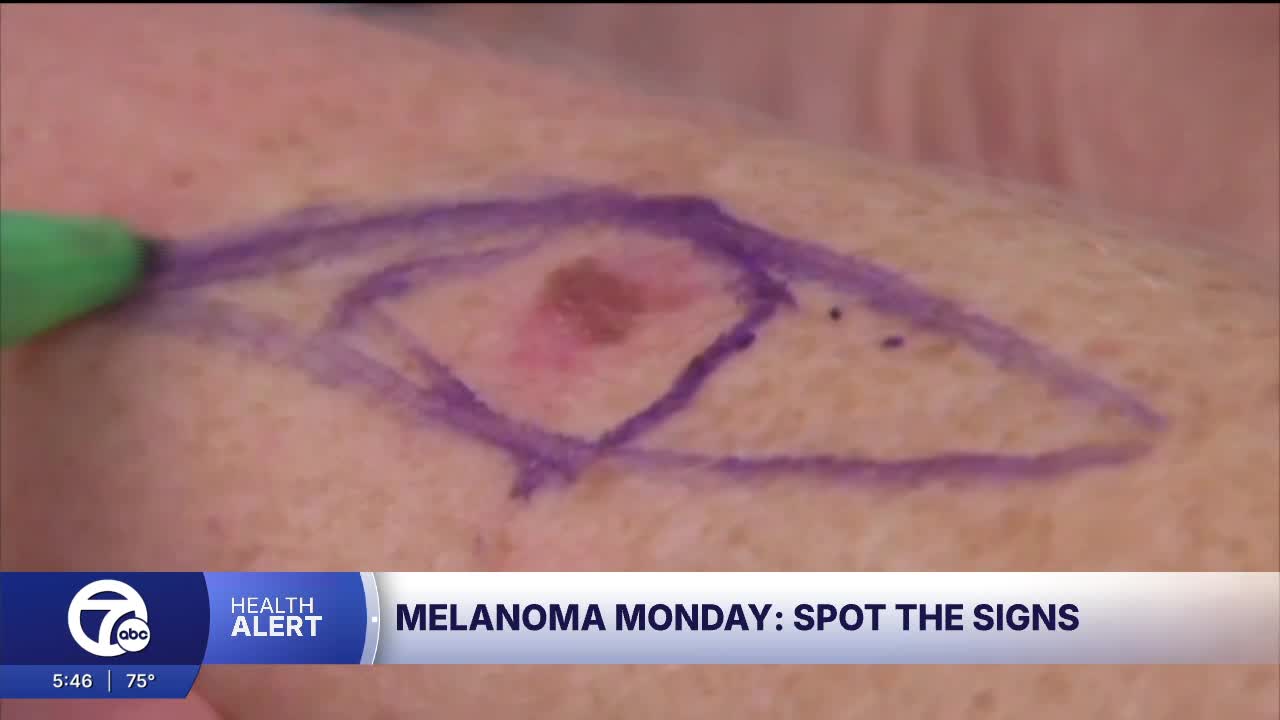


(WXYZ) — In today’s Health Alert, the entire month of May is Skin Cancer Awareness Month. But the first Monday focuses on melanoma, the most serious type of skin cancer.
Melanoma is the deadliest form of skin cancer. Over 230,000 new melanomas are estimated to be diagnosed this year, and about 8,500 people will unfortunately die from it. But here’s the encouraging part - when it’s caught early, the cure rate is about 99%.
So it’s important to know what to look for. I tell my patients to remember the ABCDE's.
- “A” is for asymmetry - one half doesn’t match the other.
- “B” is for border - edges that are uneven or irregular.
- “C” is for color – look for varying colors in the same spot.
- “D” is for diameter – melanomas are often larger than a pencil eraser, though smaller spots can still be serious.
- And “E” is for evolving – look for any mole or spot that’s changing.
Now, melanoma can develop anywhere on your body, including fingernails and toenails. Dark streaks or changes there can be a warning sign too.
One simple habit to get into is to do a skin check once a month. If something doesn’t look right, don’t wait - get it checked out. The longer it grows, the tougher it is to treat.
Some people believe getting natural sunlight is safer than using sunscreen. That’s misinformation. Sun exposure without protection increases your risk of skin cancer. The FDA has approved sunscreen, and it plays an important role in protecting your skin from harmful UV rays.
Now, it’s important to make it part of your daily routine, even on cloudy days. That’s because those UV rays are still reaching your skin. Look for broad-spectrum sunscreen products with an SPF of 30 or higher that are water-resistant. The Environmental Working Group recommends products containing zinc oxide and titanium dioxide, but the best sunscreen is the one you will use.
I also recommend sun-protective clothing, wide-brimmed hats, and sunglasses to protect your eyes. And seek shade when you can, especially between 10 a.m. and 2 p.m.
Lastly, I often hear people say that only fair-skinned folks are at an increased risk of skin cancer. That’s true, but don’t be misled - skin cancer can affect people of all skin tones and ages. So protect your skin, check it regularly, and don’t ignore changes. Early detection can make a life-saving difference.
