



(WXYZ) — In today’s Health Alert, the U.S. has made a big change to the vaccines recommended for children.
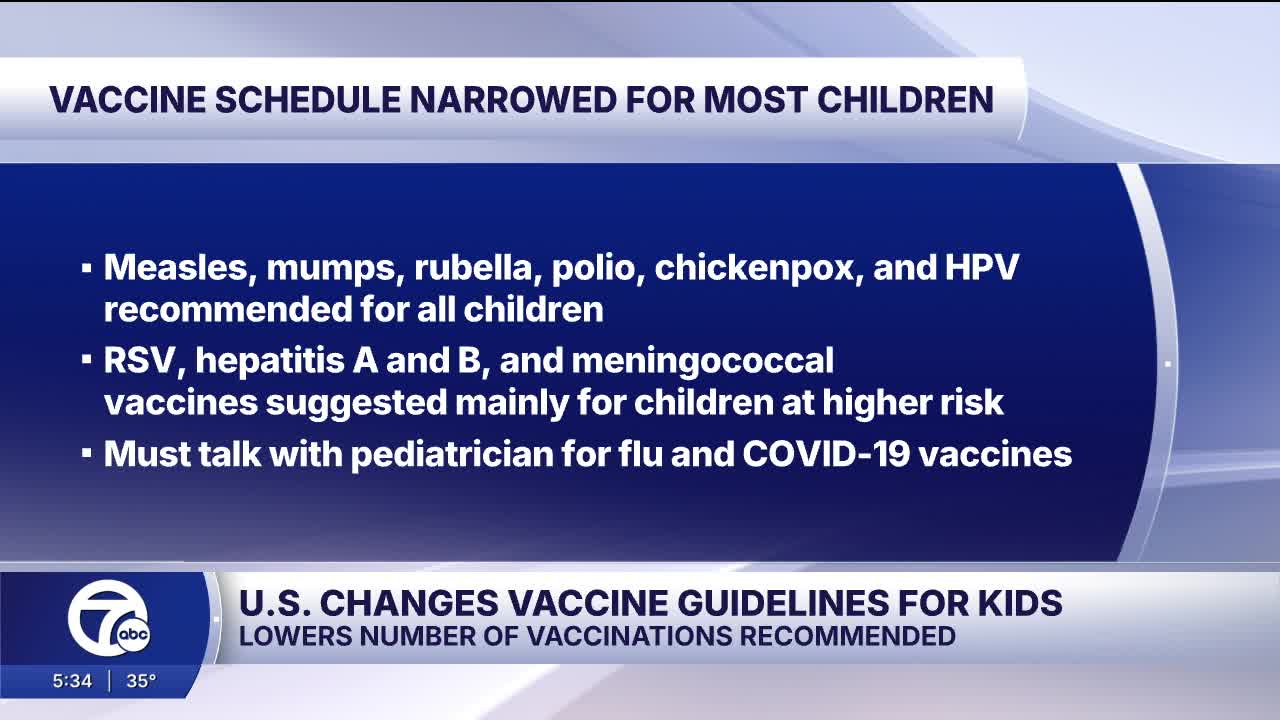
The U.S. Department of Health and Human Services recently narrowed the vaccine schedule for most children. Vaccines like measles, mumps, rubella, polio, chickenpox, and HPV are still recommended for all children. But others, such as RSV, hepatitis A and B, and meningococcal vaccines, will be suggested mainly for children at higher risk. They also recommend that vaccines for flu and COVID-19 be considered only after talking with a healthcare provider. So, parents who want these vaccines must check in with their pediatrician first.
The reasoning given for these changes is that the U.S. was an outlier compared to other developed nations – like Denmark - in both the number of vaccines and the number of doses recommended. But, comparing with Denmark is problematic because they are smaller and have a very different healthcare system. Access to excellent prenatal and childhood care is universal there.
Officials say this change focuses on the most essential vaccines and is meant to build public trust. However, many public health experts – including myself - worry this shift could increase risk in some children. In my opinion, there hasn’t been a transparent, public review of the data supporting this change.
Experts warn that lowering vaccination rates might increase illnesses, especially in communities with limited access to healthcare.
RSV can cause serious lung infections like bronchiolitis and pneumonia, which may lead to hospitalization, especially in babies. In some cases, it can even lead to severe complications or death.
Hepatitis A and B are infections of the liver. If fewer children get vaccinated, more could become sick, leading to hospital stays, long-term liver problems, and even death.
Also, meningococcal disease can cause life-threatening illnesses, including meningitis, which affects the brain, and sepsis, which affects the blood. It spreads easily when people live close together, so vaccination is especially important for college students in dorms and military recruits.
Now, the US Department of Health and Human Services said that all vaccines remain covered by insurance. But parents will need to talk with pediatricians about vaccines that are no longer universally recommended. This could be confusing and lead to lower vaccination rates. So, while these changes may confuse some families, vaccines remain one of the safest ways to protect children, and I encourage parents to speak with their pediatrician.
