

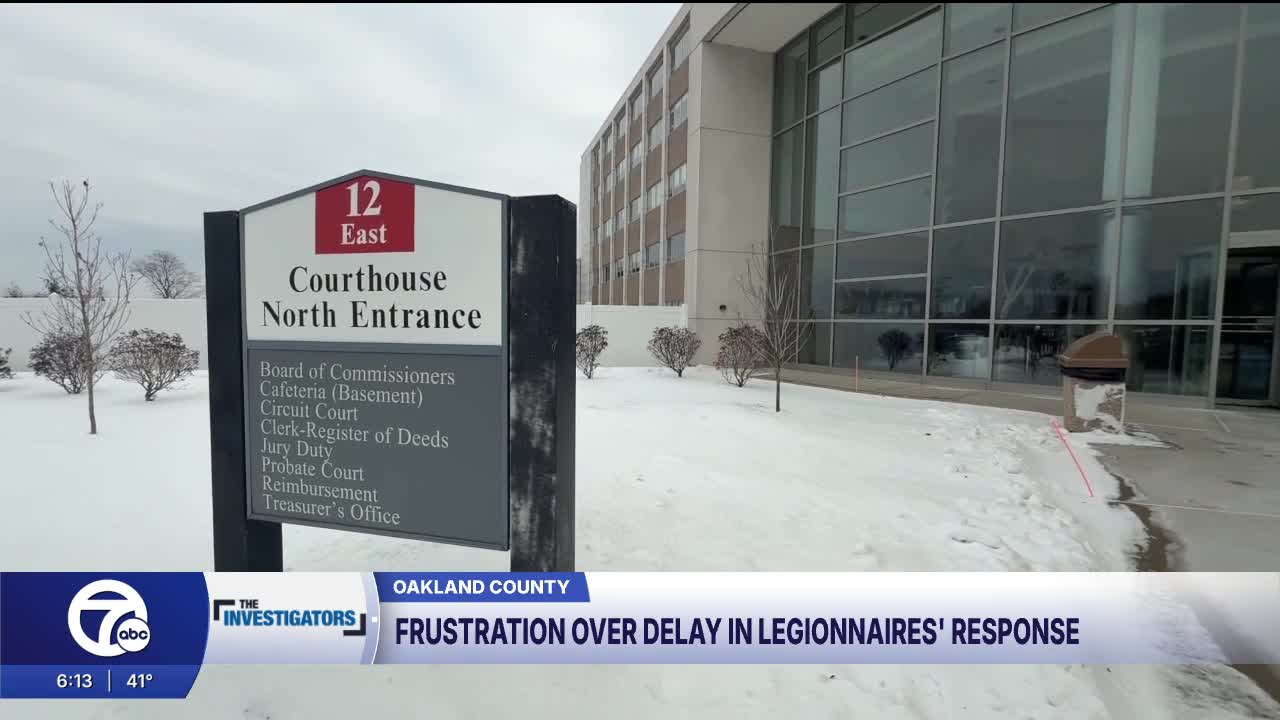


(WXYZ) — The 7 investigators were the first to report that more Legionella bacteria was found in the water system on the Oakland County campus in Pontiac.
Watch Heather Catallo's video report:
First, it was detected in the Sheriff’s Office, then it was found in the courthouse.
Now, some elected officials are questioning why they weren’t told sooner about the potentially deadly bacteria being found in the water.
Related Story: Oakland County expands water testing for Legionella bacteria to courthouse
The 7 Investigators have learned there was a delay in alerting hundreds of employees and members of the public. We also discovered that as of Tuesday, employee sinks in the courthouse still did not have special filters installed; notices not to use those sinks were not posted until after the 7 Investigators contacted county officials.
A county spokesman said the results confirming Legionella in the courthouse “were delivered by email after 3 p.m. on December 23 to a single employee whose shift is 6 a.m. – 2 p.m. The email was opened the morning of the next business day… which was December 26.”
“I'm frustrated and angry that I wasn't notified immediately,” said Lisa Brown, Oakland County Clerk and Register of Deeds.
Brown’s staff was busy at work inside the courthouse on both December 23 and December 26.
When she learned the county was notified on December 23 that 4 of 11 test sites in the Oakland County Courthouse tested positive for Legionella, she started pressing for answers and calls the delay in alerting elected officials and hundreds of employees “inexcusable.”
Related Story: Oakland County had no plan to routinely test water prior to Legionella discovery
“What do you think should have happened?” asked 7 Investigator Heather Catallo.
“I believe in treating people how you want to be treated. So, I would have contacted, at least, the elected officials in this building to let them know, so they can let their staff know,” said Brown. "The role of government should be to protect the health, safety, and welfare of its residents...."
The potentially deadly bacteria that causes a form of pneumonia was found in men’s bathrooms on the first and third floors, and in two sinks in the basement cafeteria.
Those results follow a Legionnaires' diagnosis in a custodial employee who works in the Oakland County Sheriff’s office, Building 38E, which is across the street from the courthouse.
County officials say they learned about that diagnosis on November 10, 2025, but did not test the Sheriff’s office until more than two weeks later on November 25, 2025.
Those results came back on December 4, 2025, and the county closed the Sheriff’s headquarters for remediation. It is now back open.
On December 5, 2025, the County disclosed publicly that a member of the public who got Legionnaires' disease back in April had listed the courthouse as a place he had visited.
“Was anything done to do any testing in April?” asked Catallo during an interview on December 11 with Oakland County Public Information Officer Bill Mullan.
“No, because we did not have that second case to connect it and begin testing, which is what is standard in terms of testing public buildings in Michigan,” said Mullan. “There’s no immediate risk to the public in the courthouse.”
The court complex not only houses Brown’s staff of about 100 people, but hundreds of judges, court employees, and prosecutors, plus the Treasurer’s office and the Board of Commissioners' offices. And the building is full of public restrooms where the public can easily access the water.

“Do you think the building should have been tested back in April when there was that other case?” asked Catallo.
“I'm more of a proactive person. I’d rather rule it out and be safe. I would've done the testing, but that's just the kind person I am,” said Brown.
The 7 Investigators previously reported that county officials admitted no plan was in place to regularly monitor the water system that feeds their 45 buildings.
“Why didn't the county have a regular water testing plan?” Catallo asked County Executive David Coulter on December 17.
“I don't know, it's not mandated by anyone, it is not the law that we have to or obviously we would have. But I think we're working towards that,” said Coulter.
Despite the custodial employee in the sheriff’s office testing positive in early November, no testing was done in the courthouse until December 15th and the special .2 micron filters were not added to the bathrooms in the courthouse until December 30th — 51 days after the employee’s Legionnaires diagnosis.
“It's very frustrating. I'm concerned that someone else is going to get sick,” said Brown.
The 7 Investigators visited the courthouse on Tuesday, which was fully open to the public. While the public restrooms did have filters on the sinks, several employee bathrooms still did not have filters installed. On Tuesday, photographs obtained by the 7 Investigators showed there were no signs warning employees not to use the water.
The 7 Investigators have also learned that the county only tested one water system loop in the courthouse tower. The women’s bathrooms on that loop were not tested.
“The testing follows the path of the case which includes only men’s restrooms. The Courthouse Tower is on a closed loop. It does not share water with the rest of the building,” said Mullan in an email Wednesday.
The 7 Investigators asked Mullan why the county would not test other loops in the building, such as the prosecutor’s office wing, or the Treasurer’s office, or the Board of Commissioners' offices. With Legionella in a separate “loop” in the Sheriff’s office, some employees have questioned why more locations in a busy public court building were not sampled. Mullan said they are following CDC protocol for the testing.
“I would rather be proactive. Let's do the testing. Let's put the filters on. Let's be safe, and just make sure. But I'm not in charge of this building, I'm just a tenant,” said Brown.
Brown says she’s brought in bottled water, masks, and allowed immunocompromised employees to work remotely. Brown also wants the public to know they are open, but you don't have to come to the building to access their services.
“I want people to know that many of our services are available online. So, if they don't have to come to the courthouse, that’s just a reminder,” said Brown. “I'd rather people be safe and protected and have the knowledge that before they're walking into a building where they could possibly be exposed to something that could make them sick or worse.”
Online services for the Oakland County Clerk can be
