

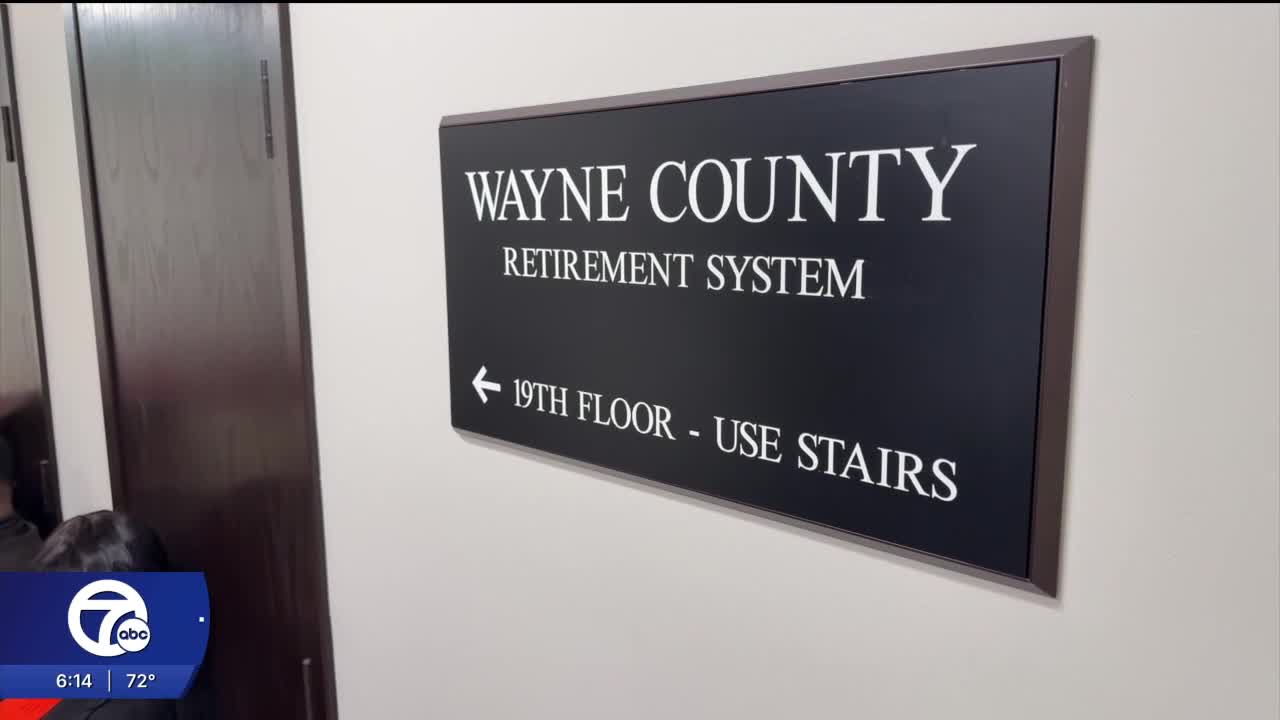


DETROIT (WXYZ) — The Wayne County retirement board voted unanimously Monday to pursue nearly $600,000 in pension benefits they say were overpaid to a retired judge.
The vote follows news last week that the county says it miscalculated the pensions of retired judges Richard Hathaway and David Szymanski, both of whom have been collecting their pensions for more than a decade.
RELATED: Wayne County says it overpaid 2 judges' pensions by $1 million, may not recover funds
At Monday's meeting, the board disclosed that a third former judge—Edward Thomas— was also deemed to have been overpaid by the retirement system. Officials did not say by how much, but the amount in question is believed to be approximately $600,000 as well.
While meetings of the retirement board are normally sleepy affairs, those in attendance Monday had a hard time finding a seat. Union members from across the county showed up early to see what steps the board would take.
“Rumblings seem to be (there’s) something funny with the money, so I’ve got to go see what’s what,” said Allen Cox, the president of the Wayne County Deputy Sheriff’s Association.
Darlene Buffington, the former vice-president of AFSCME 1659, said she saw her members have to pay back extra money accidentally deposited in their paychecks. A judge, she said, should be no different.
“No one is exempt if there are protocols and practices in place,” Buffington said.
Hathaway and Szymanski both served decades on the bench before accepting positions with the county, and when the retirement system calculated their pensions years ago, they treated all their years of service as the same.
That was a mistake, the county now says, because judges are paid mostly by the state, not the county.
When they recalculated their pensions, both men saw steep decreases: Szymanski's pension fell from about $81,000 a year to about $36,000, and Hathaway’s $101,000 pension dropped to about $66,000.
After emerging from closed session Monday, board members voted 7-0 to reject a settlement offer made by Hathaway—they declined to disclose details of the offer—and authorized county lawyers to go to court to pursue the $595,000 they say was overpaid.
“We denied it and instructed Wayne County corporation counsel to seek what was owed and to continue on with the litigation process,” said Deputy County CEO Assad Turfe, who also serves on the retirement board.
Turfe said the decision was not a difficult one.
“It wasn’t a tough call at all. This is good governance. This is what the fiduciary responsibility of the board is,” he said.
Hathaway did not respond to a call or e-mail seeking comment on today’s news.
Today’s vote did not address the money already paid out to Judge Szymanski—about $450,000—largely because Szymanski has already taken the county to court, arguing that his pension should have never been lowered in the first place.
In an e-mail Monday afternoon, Szymanski said the county was wrong to lower his pension.
Monday afternoon, Szymanski sent an e-mailed statement to 7 News Detroit:
“It is critical to understand that what they pose as an overpayment is a premise with which we do not agree, that the calculations were wrong and that I was overpaid. That is not an established fact. It is exactly what we are challenging. Even setting aside our arguments that WCERS had no authority to reopen my pension in the first place, their recalculation itself is incorrect. The Retirement Ordinance provides a single formula: Average Final Compensation is based on the member's five highest consecutive years of compensation, applied to total credited service. My five highest consecutive years were my years as County Treasurer, when I earned approximately $155,000 in purely county-paid salary with no state component and no coordination statute issue whatsoever. Under the Ordinance's formula, that $155,000 AFC applies to my full 25.67 years of service, which produces essentially the same pension I was originally awarded. The only way WCERS arrives at $36,180 is by splitting my career into two separate calculations with two separate AFCs, one for the judicial years and one for the Treasurer years. Nothing in the Ordinance authorizes that kind of bifurcation of service. The formula is one member, one AFC, one calculation. So even on their own terms, the claim that I was overpaid does not hold up. Should a person start with the County as a clerk in the Sheriff’s department and later accept a higher paid position with the Clerk, they do not cap the years with the Sheriff and start a new clock with the Clerk’s office. That is precisely what they are trying to do here without justification.”
Contact 7 Investigator Ross Jones at ross.jones@wxyz.com or at (248) 827-9466.
