


As Michigan continues its battle against potholes, engineers and transportation officials across the state are working on innovative solutions to create stronger, more durable roads that can withstand the harsh climate conditions that plague communities year-round.
I spoke with drivers and experts about emerging technologies that could revolutionize how we approach road construction and maintenance in Michigan.
See the full story in the video below
"There's a joke, when you enter Michigan you can tell you're in Michigan, because you hit potholes," said Rachelle Hatter, a Southfield driver.
But Hatter isn't laughing about the persistent problem affecting drivers statewide.
"We need more tech, need to look into more tech," Hatter said.
At Ferris State University, Walker Glass leads certification classes that are crucial to improving Michigan road durability. The classes focus on aggregate inspection for the Michigan Department of Transportation.
"Anybody testing materials that go into roadway projects funded by the state have to be certified," Glass said.
The process involves testing different types of stone and concrete blends to determine which materials perform best under Michigan's challenging climate conditions.
"There are certain types of stone that are not good for concrete. Blends of concrete mixes that have performed well in the past, we can create that, replicate that. Data that we track from these tests will eventually and has made roads more durable and hold up to the climate we get in Michigan," Glass said.
The County Road Association of Michigan recently launched the Local Road Research Program to explore new technologies for extending pavement life.
"You know there's been a lot of research on extending the life of concrete and asphalt pavements," said Darrell Cass, chair of Local Research Road Program Board for County Road Association of Michigan.
"And one of the technologies we're aware of is you can use rubberized asphalt to overlay an existing road," Cass said.
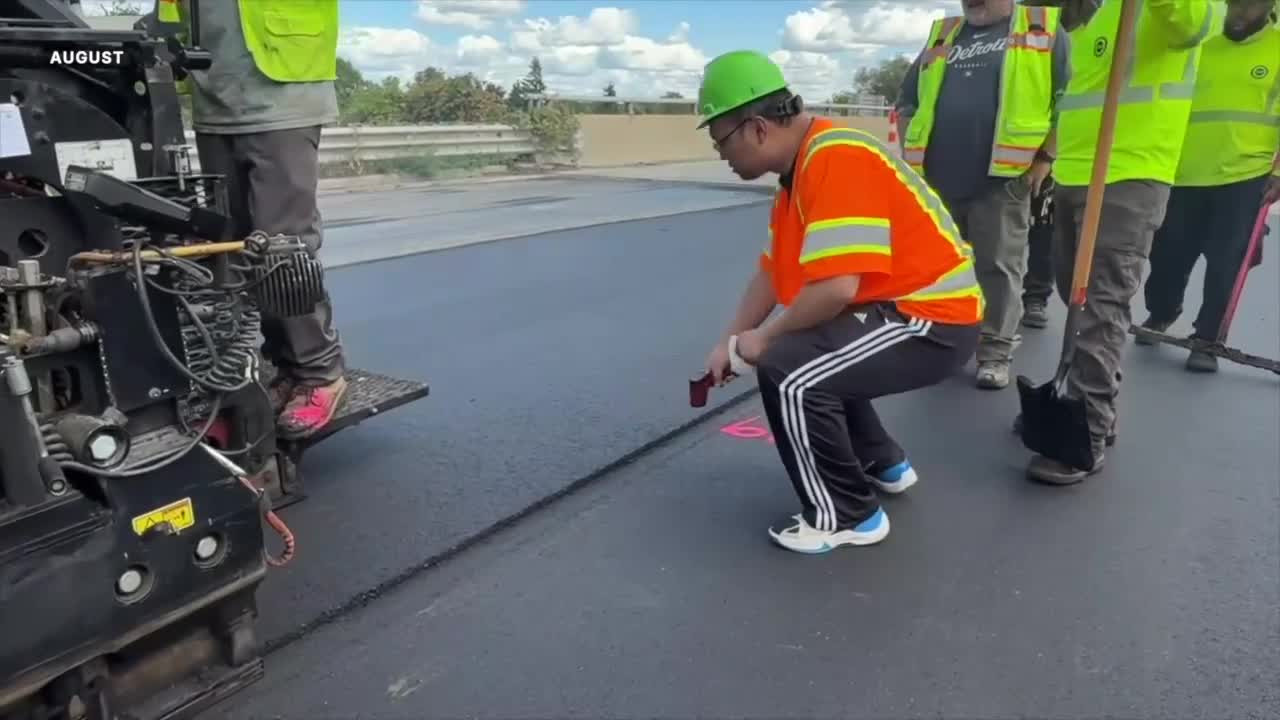
In August, the Washtenaw County Road Commission used rubber asphalt for the first time on a one-mile stretch. The EGLE-funded project represents a partnership between the county and Michigan Technological University.
Watch below: Washtenaw County tests innovative rubber asphalt made from scrap tires
Dr. Zhanping You, a civil engineering professor at Michigan Tech who has studied rubber asphalt for decades, explained the benefits of incorporating recycled tire materials into road construction.
"The rubber materials from tires, there are a lot of good components we can potentially use for roads," You said.
"Will be have more elasticity so therefore it's not likely to have issues like rotting, cracks, potholes," You said.
Michigan State University is also contributing to infrastructure innovation. Late last year, researchers celebrated the installation of four slabs of self-heating and self-healing bendable concrete on campus. Researchers will collect data from the slabs and use it to potentially improve infrastructure across the state.
For drivers like Hatter, these technological advances can't come soon enough.
"We definitely need it, and it'll be better in the long run," Hatter said.
This story was reported on-air by a journalist and has been converted to this platform with the assistance of AI. O
