


(WXYZ) — In today’s Health Alert, an invisible gas in your home could be raising cancer risk in women. New research links radon exposure to ovarian cancer, especially if there’s a family history of breast cancer.
Radon is a radioactive gas. It’s invisible, so you can’t see it, smell it, or taste it. It’s released naturally from rocks, soil, and water. And it can get trapped and build up inside homes - especially in basements and lower levels.
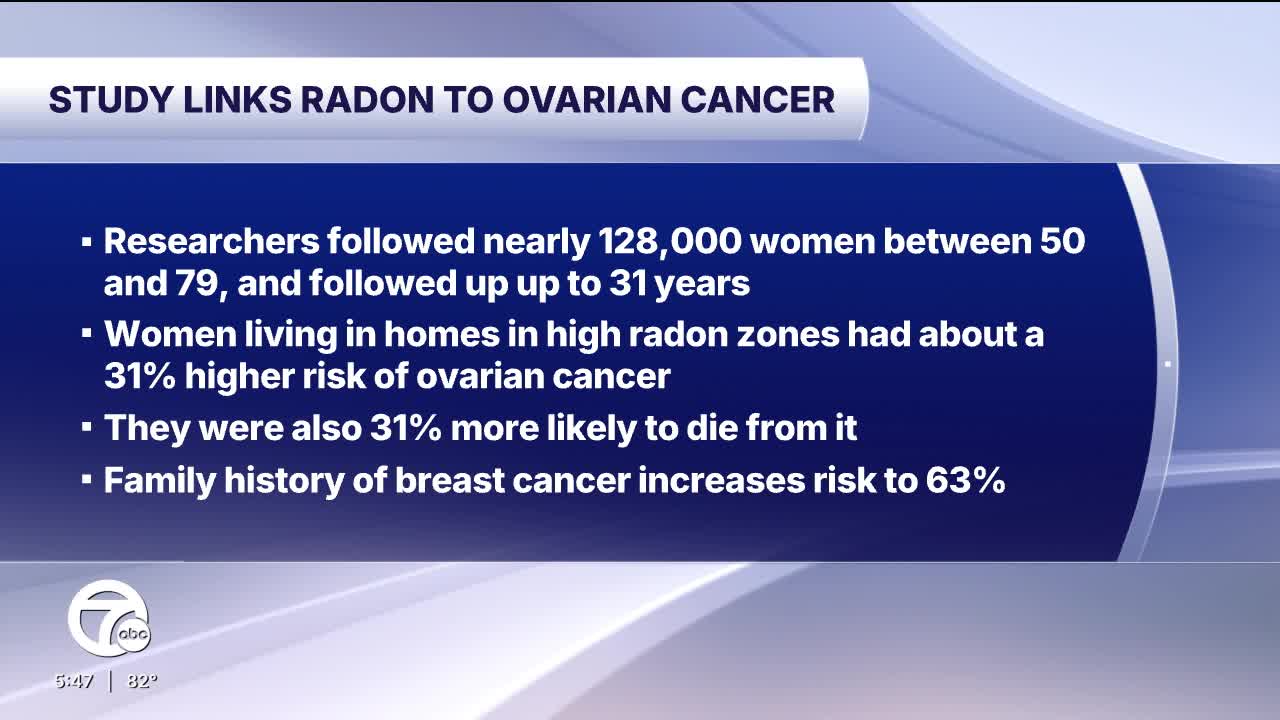
Now, we know that radon is the second-leading cause of lung cancer. But this new study is the first to connect it to ovarian cancer. Researchers followed nearly 128,000 women participating in the Women’s Health Initiative. They were between 50 and 79, and followed for up to 31 years.
And here’s what they found. Women living in homes in high radon zones had about a 31% higher risk of ovarian cancer. They were also 31% more likely to die from it. And what was really eye-opening is this — if a woman had a family history of breast cancer, her risk went up even more — about 63%.
How can families check for radon, and if levels are high, what can they do?
First, you can check maps from the Environmental Protection Agency. It shows areas of Metro Detroit that fall into moderate and higher radon zones. That said, the maps are just a guide. The only way to really know your risk is to actually test your home. You can buy test kits at hardware stores or online. They’re affordable and easy to use.
Now, the Environmental Protection Agency suggests you fix your home if your radon level is 4 picocuries per liter or higher, and consider fixing it if your level is between 2 and 4. It’s best to hire professionals trained to address radon issues. They can install systems that reduce exposure and safely vent the gas out of your home.
Lastly, from a health standpoint, if home radon levels are high, it’s a good idea to talk to your healthcare provider. For women, ask about your ovarian cancer risk and ways to lower and screen for it, especially if there’s a family history. And regardless of sex, if you smoke or used to, be sure to ask about lung cancer screening to help detect tumors early.
Testing your home is simple. And it could make a real difference for your long-term health.
