

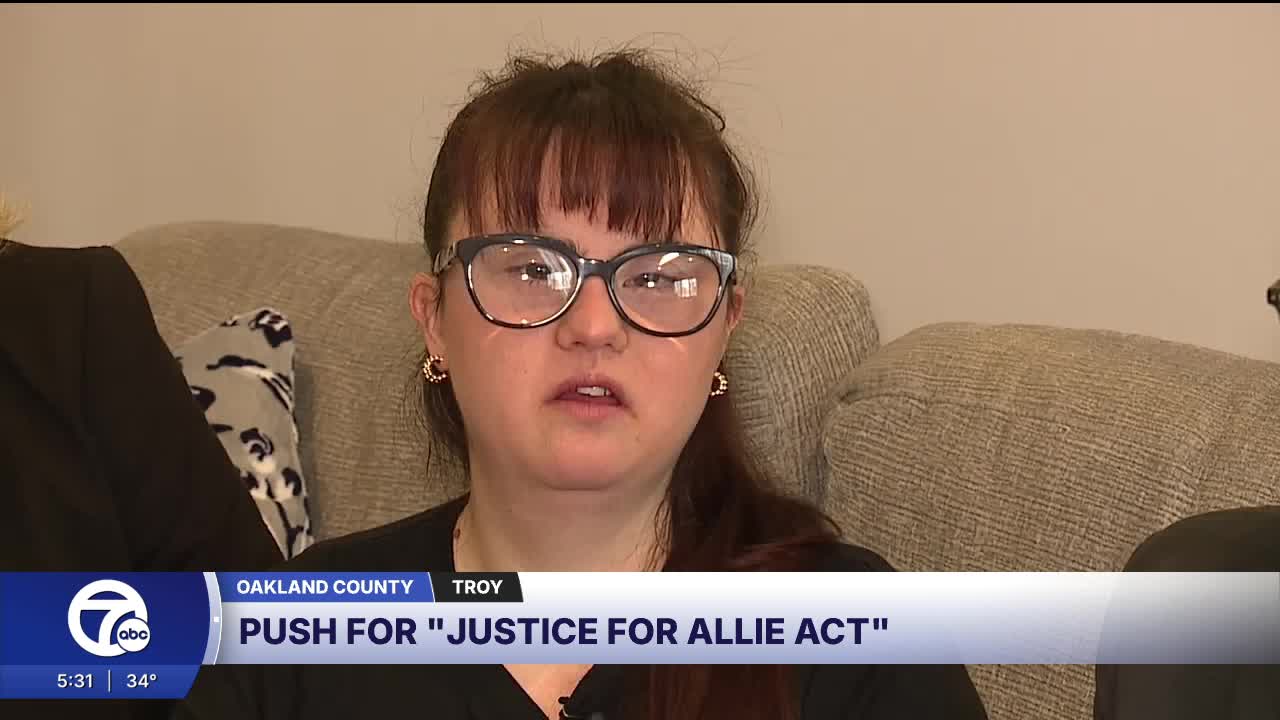


TROY, Mich. (WXYZ) — A Troy woman with Down syndrome who was targeted by an online predator is now at the center of a push to make federal law.
Allie Hayes, 28, was 18 years old in 2017 when a predator intentionally targeted her online because she has Down syndrome and coerced her into sending sexually explicit photos. Police arrested the man involved, but because Hayes was a legal adult, prosecutors had few legal options to hold him accountable.
Watch Brett Kast's video report below:
“When this whole thing happened to Allie, it was super sad for us, but we knew right from the get-go we had to make a difference,” said Allie's father, Mark Hayes.
For the next six years, the Hayes family worked with state lawmakers to write legislation making it illegal for online predators to knowingly target vulnerable adults and manipulate, coerce, or force them to take explicit photos. It was Allie's decision to eventually speak publicly and advocate for the legislation.
Previous Story: 'Justice for Allie': Troy family pushes for change after online predator targets daughter
“I like advocating because I want to make the world a better place for people with disabilities,” said Allie. "I want to change the world for the better for people who are like me, and I'm very proud of myself for doing that."
In 2023, two bills passed unanimously and were signed into law by Gov. Gretchen Whitmer — legislation known as "Justice for Allie."
Now, two local congresswomen are pushing to take 'Justice for Allie" to the national level.

U.S. Reps. Debbie Dingell, Ann Arbor, and Haley Stevens, Birmingham, have officially introduced the Justice for Allie Act in Congress today — federal legislation modeled closely after the Michigan law, which earned unanimous bipartisan support. The federal version includes language that adds "with the intent to cause harm."
"This bill is named in honor of her (Allie) because of what she experienced and her courage in talking about it," Dingell said. "I don't think this is a partisan issue, this is a responsibility that we all have.”

"Allie and her family, they're pretty convincing. She's a pretty special person," Stevens said. “This landmark legislation will put up federal guardrails, federal offenses for those who intend to do harm to exploit those with intellectual and developmental disabilities, no matter their age.”
Allie's mother, Dawn Hayes, hopes having the law become national will help families in other states.
Previous Story: Woman behind 'Justice for Allie' gets recognition, consideration in Washington
"Last summer we were at a national conference and Allie's law was being discussed, and we were approached by several families who offered anecdotal stories where this happened to their daughter," Dawn said. “These online predators need to be dissuaded that there is a new law out there that can be applied.”
The Hayes family hopes it can pass as soon as possible, noting "Justice for Allie" is only justice because of Allie.
"As a Dad, I couldn't be more proud of Allie. Just the perseverance, the resilience, has been unbelievable," said Mark. "Even though this won't change anything about what Allie went through, it certainly will help protect others in her same situation."
The Justice for Allie Act has been officially introduced in Congress. Multiple local advocacy organizations have spoken out in support of the legislation.
"We fully support The Justice for Allie Act, which will be critical to ensuring the safety and protection of our community. Safety and wellbeing are foundational to living the most supported and/or independent life,” said Dr. Colleen Allen, President and CEO of the Autism Alliance of Michigan. “This legislation goes a long way to extending the protections set forth in our state law here in Michigan. We applaud Representative Stevens for her leadership in advancing this bill and her commitment to individuals living with autism and their families."
"The Justice for Allie Act advances safety, self-determination, and community inclusion — which are core independent living values — by strengthening deterrence and accountability for online coercion and exploitation of individuals with disabilities, especially when the abuse crosses state lines," said Kelly Winn, CEO of the Disability Network of Eastern Michigan.
"The Michigan legislature acted when vulnerable citizens needed protection. The Justice for Allie Act works, and Disability Rights Michigan supports passing this legislation at the federal level,” said Michelle Lindsay, Executive Director of Disability Rights Michigan. “We encourage Congress to send a message that exploitation of individuals with disabilities, across all state lines, is not tolerated."
This story was reported on-air by a journalist and has been converted to this platform with the assistance of AI. Our editorial team verifies all reporting on all platforms for fairness and accuracy.
