

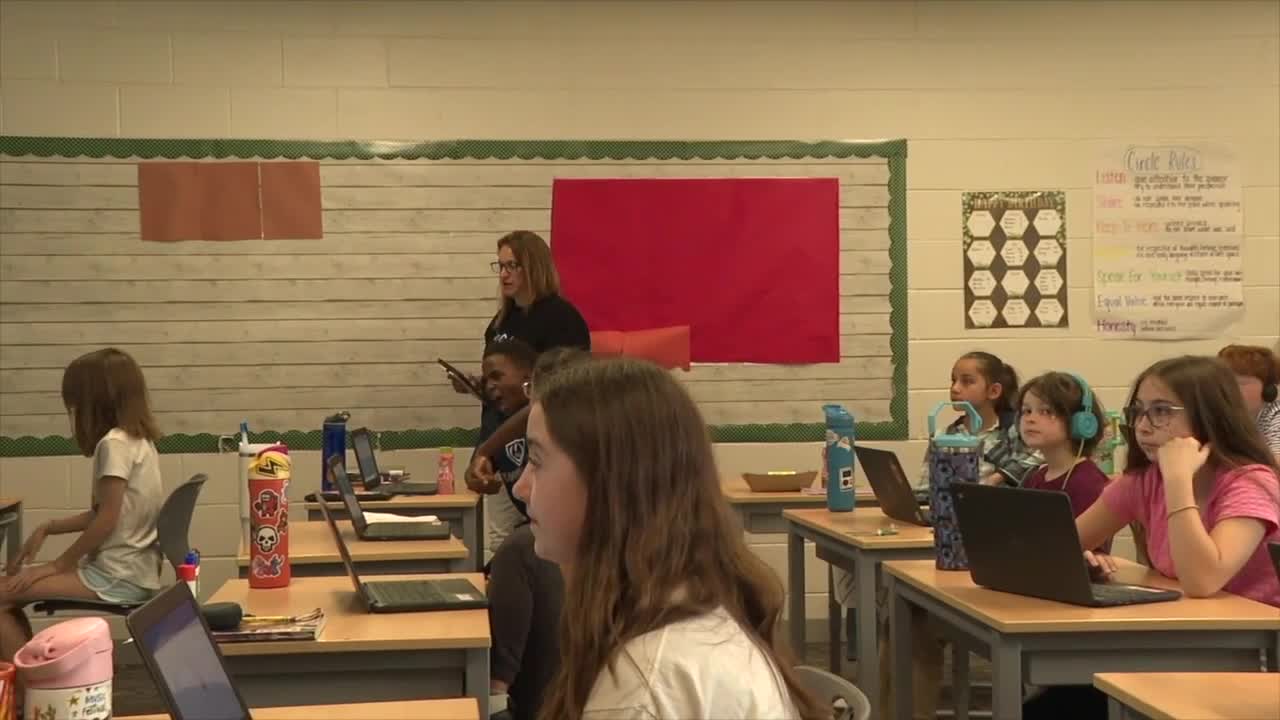


(WXYZ) — For years, schools raced to put laptops, tablets and learning apps into classrooms. But now, a growing body of research is asking a sharper question: Is all that technology actually helping children learn, or creating new problems for attention, privacy and health?
See the full story in the video below
From calculators in the 1970s to computers in the 1980s and 1990s, schools have always wrestled with technology. But the COVID-19 pandemic changed the speed and scale. Almost overnight, screens became the way many students accessed school, and now some are asking if the digital tools meant to advance education are limiting learning.
"What we tend to do is we mistake engagement for attention and learning," Dr. Julie Brociszewski, a clinical psychologist and mother of two, said.

Brociszewski said just because kids are interacting with devices in school doesn't mean they're absorbing the material. Her concern is the cumulative screen exposure, especially when learning apps are borrowing from the same reward systems that keep kids clicking.
"My own kiddos play gamified education apps and they have a lot of fun. But what it creates is surface learning," she said.
Across the country, schools are now re-evaluating how much technology belongs in the classroom. The concern is that students may appear to be focused on learning apps, but struggle to read for understanding, write by hand, do math off-screen or sit with frustration.
"Our literacy scores, through all grade levels, we were getting 20, 30, 40% proficiency, which tells me we're getting 60, 70, 80% that are not proficient," Mesick Community Schools Superintendent Jack Ledford said.

In Mesick Community Schools, in northern Michigan, Ledford said his district is actively pulling back on tech in the classroom. Earlier this year, his district started moving K-5 students away from Chromebooks and back toward actual books, writing on paper and face-to-face learning.
"Our kids are now more engaged. They're more calm. And so we've seen some good things so far from it," he said.

The long-term test will be whether literacy scores improve. But not everyone believes the answer is removing technology altogether.
"Education screen use is not the same as entertainment screen," Liz Kolb, a clinical professor of teacher education and learning technology at the University of Michigan, said.

Kolb said the research does not support treating all screen time the same. A child scrolling videos alone is not the same as a child using technology to analyze data, record reading fluency or get targeted feedback from their teacher.
"Purpose matters much more than the minutes or the screen time alone," Kolb said.
That middle ground is where many districts are trying to land.
"There's gotta be a balance and kind of an equilibrium that exists there," Novi Community School District Superintendent Ben Mainka said.

Novi isn't abandoning classroom technology, but Mainka is asking harder questions about when devices help and when they get in the way.
"We don't wanna just remove technology completely because they have to go into a world where they're going to be engaging with technology," he said.
That's the challenge for families and schools – not whether tech belongs in the classroom, but when it helps, when it hurts and what it may be crowding out.
"Learning is kind of like building muscle. You have to have a little bit of resistance to make it happen," Brociszewski said.
Experts say technology itself is not the problem. The concern whether schools are using it with enough intention, enough evidence and enough limits.
Researchers say families can ask a few basic questions: How are these apps vetted? What student data is being collected? How much of the school day is happening on screens?
