

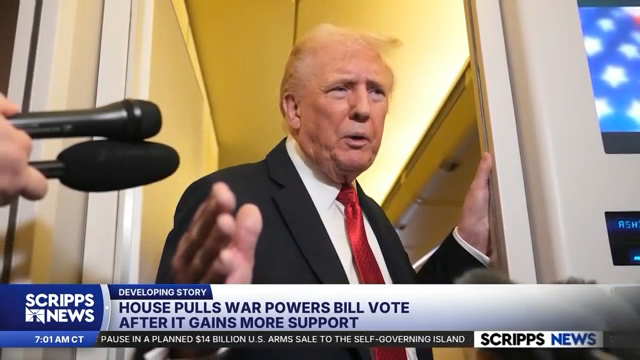


House Republican leaders pulled a Democratic bill Thursday that would have forced President Trump to withdraw from the war with Iran, backing off after it became clear they did not have enough votes to defeat it.
The move came just days after a handful of Senate Republicans joined Democrats to advance a bill that would limit the president's war powers in Iran — a vote that raised concerns about how the White House might respond.
While the vast majority of Republicans on Capitol Hill still stand with Trump, the party's slim majority means even a small number of defections could have been enough to pass the War Powers Act and send it to the White House.
"If there had been some indication that this was going to be a forever war, which there is no indication that it's going to be a forever war, I could understand the position that some of my colleagues are taking. I just disagree with my colleagues that want to pass a War Powers Act," Sen. Cynthia Lummis, a Wyoming Republican, said.
If the War Powers Act does reach Trump's desk, a veto appears more than likely. Congress does not appear to have the two-thirds majorities in the House and Senate needed to override one.
The war powers fight is not the only source of friction between Senate Republicans and the White House. Lawmakers left Washington early for Memorial Day recess without voting on a $70 billion reconciliation package that Trump had set a June 1 deadline to pass. Congress will not return until June 1.
Sen. Chris Coons, D-Del., who had prepared to stay late into the night Thursday — possibly into the early morning hours — to try to pass the package before the deadline, described the Republican conference as fractured.
RELATED STORY | Congress likely to miss Trump-imposed deadline to fund ICE
"President Trump chose sides in two primaries. One's already gone badly. The other one's looking like it may, and as a result, you've got Republicans internally in disarray about exactly what they're willing to support, including specifically a billion dollars for a ballroom and $1.7 billion for a settlement fund, where there's a lot of blowback from their home states," Coons said.
A meeting between Senate Republicans and Acting Attorney General Todd Blanch reportedly turned ugly over a $1.8 billion settlement fund. Some Republicans have discussed adding guardrails to the fund, but there are concerns the White House would not welcome those restrictions — and that Trump could veto the very bill he pushed Congress to pass if such guardrails were included.
The reconciliation package also includes $1 billion in funding for security at Trump's ballroom. The Senate parliamentarian ruled that provision does not comply with the strict rules Republicans must follow under the reconciliation process. Questions remain about whether Republicans will attempt to rewrite the provision to satisfy the parliamentarian's requirements.
RELATED STORY | Rapid redistricting reshapes US political map ahead of 2026 midterms
Trump pushed Senate Republicans to fire the parliamentarian altogether. That effort appeared to gain little traction. Sen. Tommy Tuberville expressed support for removing the parliamentarian, but few other Republicans joined him. Senate Majority Leader John Thune did not express any willingness to fire the nonpartisan referee.
Whether the $1 billion in ballroom security funding will remain in the package is unclear. Enough Republicans spoke out against including it that its prospects appeared uncertain heading into the recess.
