
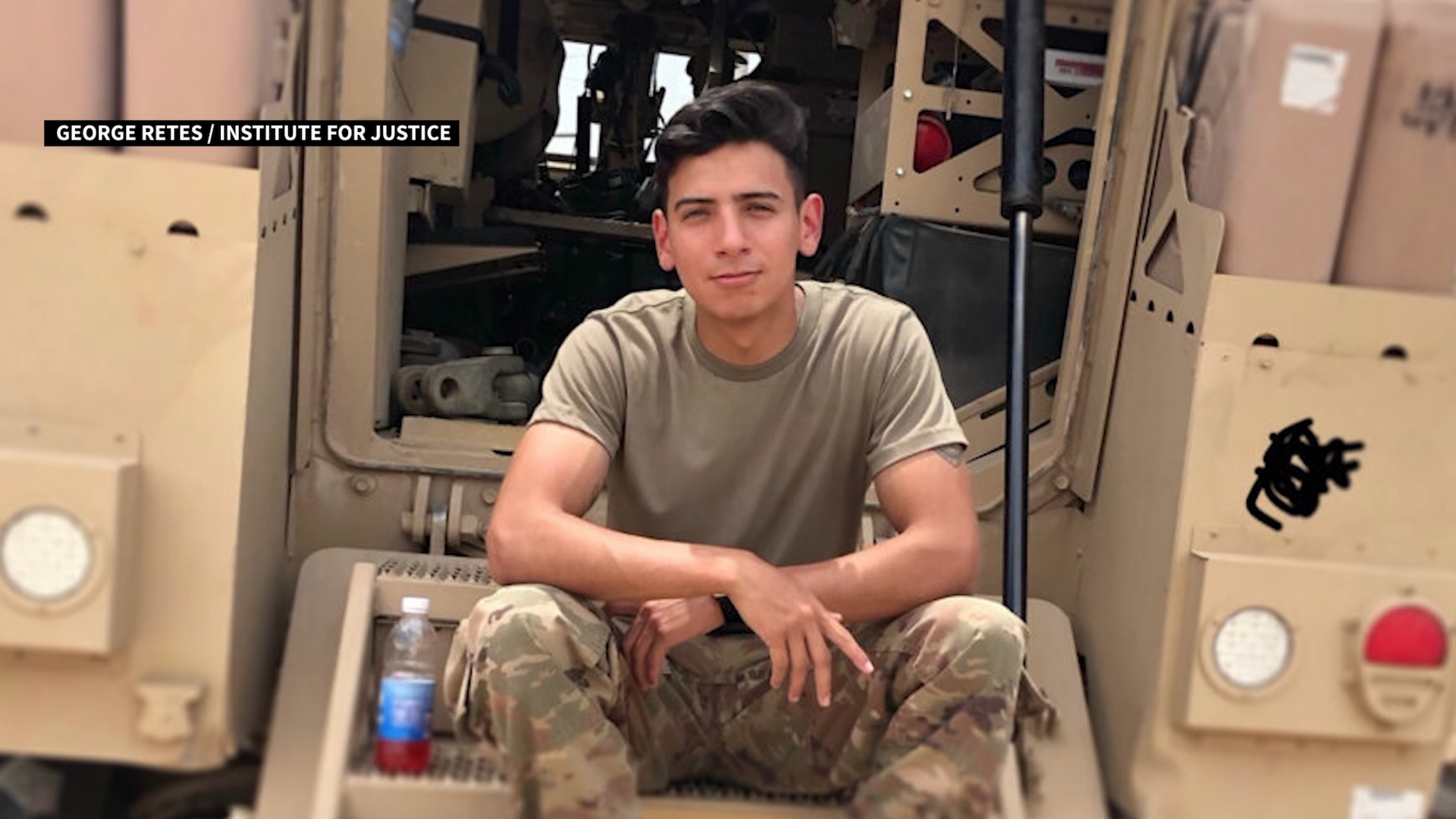


As President Donald Trump was delivering the first State of the Union address of his second term on Tuesday night, asserting that he and Congressional Republicans were “the only thing standing between Americans and a wide open border right now,” George Retes was in the House Press Gallery watching on – and feeling grateful to be alive.
“It was an amazing experience,” Retes told Scripps News in an interview. “Although it wasn't under the best of conditions, it was still a great opportunity.”
Seven months prior, Retes found himself placed on suicide watch in a holding cell at the Metropolitan Detention Center in Los Angeles, California. For three days, Retes, then 25 years old, was held with no access to legal representation, no opportunity to shower the tear gas and pepper spray off his body, no chance to attend his three-year-old daughter’s birthday party, nor let the rest of his family know where he was.
"No lawyer, no phone calls, family, no hearing before a judge, no shower, no nothing,” he said.
Retes’ presence at the State of the Union, invited as a guest of Rep. Mark Takano (D-Calif.), was meant to highlight the far-reaching impacts of the Trump administration's immigration enforcement crackdown.
“George Retes is a U.S. citizen and an Iraq War veteran, and yet he was treated like an enemy by his own government,” Takano, the top Democrat on the House Committee on Veterans’ Affairs, said in a statement. “His story exemplifies the overreach and cruelty of the Trump Administration and their heavy-handed immigration policies, sweeping up innocent men, women, and children in a desperate bid to fill arbitrary quotas.”
It was July 10, 2025, when Retes — a U.S. citizen and disabled Army veteran at one point deployed to Iraq — showed up to work as a security guard outside a cannabis farm in his native Ventura County, California, only to discover a large-scale immigration raid in progress. Despite repeatedly attesting to his status as a citizen and trying to comply with what he said were contradictory orders from federal immigration officers, Retes was arrested and soon transferred to the detention center in Los Angeles, never once told what he did wrong.
“They leave the lights on 24/7. I'm in there naked, in a hospital gown,” Retes recalled. “A guard sits out there 24/7 with the glass door just making sure I don't kill myself.”
After approximately 72 hours, Retes was released with no charges and no answers for why he was detained.
“They said all the charges on me were dropped and that I was free to go, no explanation,” he said. “They walked me out, and that was it.”
After initially remaining silent about the incident, Department of Homeland Security officials subsequently claimed — as Retes began sharing his story publicly — that he was “violent” and “refused to comply with law enforcement.”
“[Retes] challenged agents and blocked their route by refusing to move his vehicle out of the road. CBP arrested Retes for assault,” DHS said in an Oct. 1 statement.
But Retes maintains his innocence.
“There’s helicopter footage of the entire thing,” he noted. “They released me without charges, zero charges.”
Indeed, local news footage appears to show Retes complying with federal officials’ orders to back up his car and show no apparent confrontation before tear gas was deployed.
DHS did not respond to Scripps News inquiries about Retes’ story or officials’ initial characterization of his arrest.
RELATED NEWS | Do ICE agents truly have ‘absolute immunity’?
Retes’ story is not unique; news outlets, including ProPublica, have identified more than 170 U.S. citizens held by immigration agents, figures partially validated by an investigation from Senate Democrats late last year.
But Retes is among the first to challenge such arrests in court, having recently completed the lengthy and bureaucratic process mandated by the Federal Tort Claims Act, which requires those alleging negligent or wrongful acts by federal officials to first file an administrative claim and give federal authorities six months to respond.
Retes’ lawsuit, filed in federal court in the Central District of California, claims violations of his civil rights under both state law and the U.S. Constitution. The case seems relatively straightforward but it will be an uphill battle, his attorneys concede.
“It's really a question of the law,” Marie Miller, an attorney with the Institute of Justice working on his case, told Scripps News. “What legal remedy is he entitled to under what theory, and are federal officers truly above the law or not?”
The Trump administration claims they are, at least in most situations. In the wake of federal immigration officers’ fatal shootings of U.S. citizens Renee Good and Alex Pretti in Minneapolis, Minnesota, administration leaders maintain federal officials are entirely immune from legal challenges.
“The precedent here is very simple: you have a federal law enforcement official engaging in federal law enforcement action — that’s a federal issue,” Vice President JD Vance told reporters shortly after Good’s death. “Any lawsuits seeking to challenge alleged wrongdoing would “get tossed out by a judge,” he added.
Indeed, while existing laws make it easier to challenge state and local officers’ actions, the U.S. Supreme Court has extended broad immunity doctrines to federal officials, limiting their liability.
Nonetheless, Retes says he won’t back down from his push for justice.
“I get like it's almost impossible to sue federal officials and get any accountability, but I have hope that everyone sees what's happening is wrong, and that what they're doing shouldn't be legal, and that they should be held accountable for their actions,” he said.
Those working on his case say it could ultimately end up before the Supreme Court, possibly serving to change those precedents and enable other, similar lawsuits to move forward.
Retes, meanwhile, says he feels it’s his duty to speak out as others who faced similar situations — Good and Pretti, especially — are unable.
“The only difference between me and Renee Good or Alex Pretti is that the officers who were there and did all this to me weren't as trigger-happy as the other agents,” Retes said. “It honestly hurt so much to sit here and just think about it, because, literally, it could have been me.”
MORE ON IMMIGRATION | ICE in America: Examining immigration enforcement in Minnesota and its impact
