

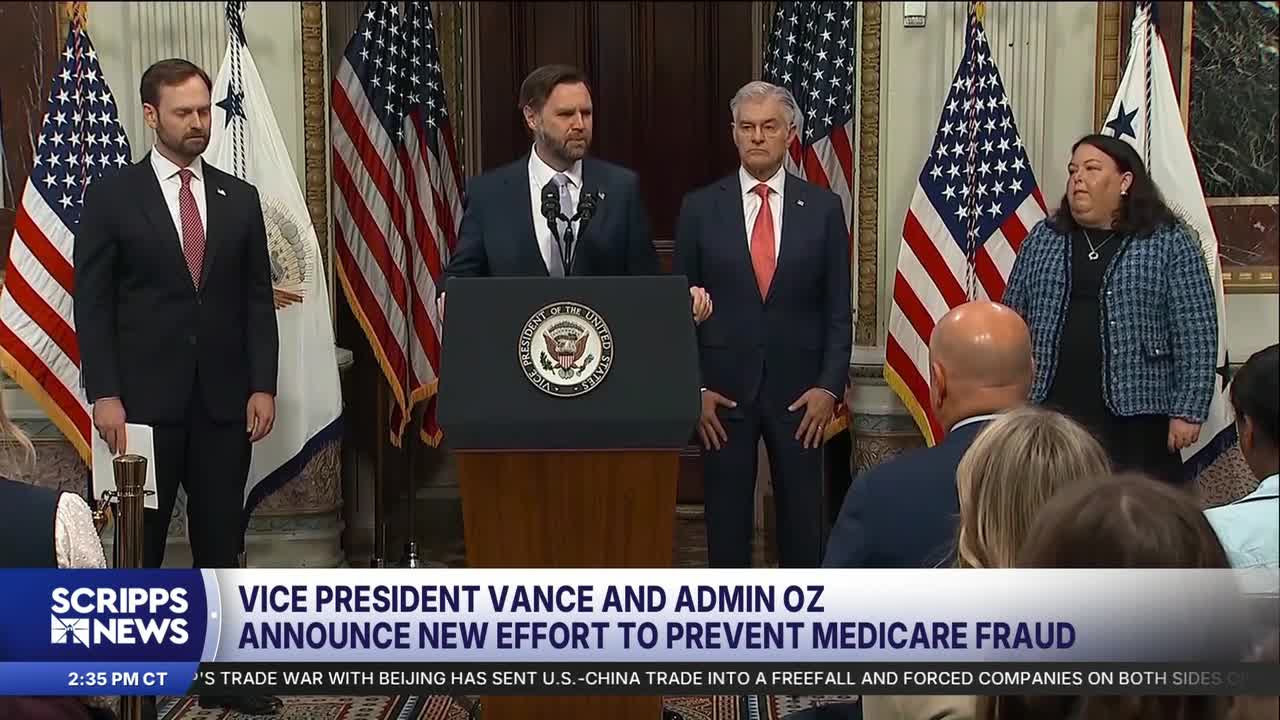


Vice President JD Vance on Wednesday announced new steps in the Trump administration's initiative to root out fraud in federal health programs, including a $1.3 billion deferral in Medicaid reimbursements to California.
"How long are people going to pay into programs if they know that that money doesn’t go to a low-income kid who needs health care, but that money goes into a fraudster getting rich?" Vance said during an event at the White House, adding that taxpayers and program beneficiaries are victimized by such fraud.
The Republican administration is also imposing a six-month freeze on some new Medicare enrollments and warning states to investigate Medicaid fraud or risk losing funding, officials said.
The moves are part of Vance’s anti-fraud task force, which has been taking more aggressive steps to investigate states before the November elections. The panel set up by President Donald Trump seeks to crack down on potential misuse of public money.
Vance, a potential 2028 White House hopeful, has used the high-profile assignment from Trump to remind Americans struggling with high costs that he is trying to claw back taxpayer dollars. Vance has promoted the task force’s work during campaign stops for Republican candidates and is expected to focus on the effort Thursday in Maine, which has closely watched primary races scheduled for June 9.
The steps come as people across the United States have raised concerns about rising health costs and barriers to access, sometimes from the federal government’s own actions. New work requirements in Medicaid, for example, are expected to strain hospitals around the country and result in millions of enrollees losing their health coverage.
The administration contends its vigorous fraud-busting efforts will help prevent wrongdoing in Medicaid and Medicare while preserving funding and resources for those most in need.
Deferring $1.3 billion in California payments
Dr. Mehmet Oz, who leads the Centers for Medicare and Medicaid Services, said the administration was making the “largest deferral we've ever made” in Medicaid funds and that it was justified.
He claimed the administration had identified questionable expenditures and anomalies, such as a higher rate of growth in California's home care program compared with other states. He did not provide concrete examples of documented fraud.
“We'd like the state to at least come to the table and explain to us how these outlier payments have been generated,” he said.
The press office of Gov. Gavin Newsom, D-Calif., disputed Oz's claims and said the state's home care program grew because the state is “keeping more people OUT of far more expensive nursing homes.”
“We hate fraud,” the office wrote on X. “But that's NOT what this is.”
The total cost of California’s Medicaid program, including state and federal funding, is expected to be about $222 billion for the budget year that starts July 1.
Nationwide freeze on some new Medicare provider enrollments
Oz's agency also announced a nationwide six-month moratorium on all new Medicare enrollments by providers of hospice and home care.
“Today we’re shutting the door on fraud — preventing new bad actors from entering Medicare while we aggressively identify, investigate, and remove those already exploiting them," he said in a statement.
Existing hospice and home health care providers will continue to operate as usual. But CMS said it will “intensify targeted investigations, deploy advanced data analytics, and accelerate the removal” of providers in the category that are suspected of fraudulent activity.
Such a freeze is not unprecedented, said Tricia Neumann, a senior vice president and executive director for the program on Medicare policy at the health care research nonprofit KFF. She said President Bill Clinton’s Democratic administration also imposed a temporary moratorium on home health agencies.
“A brief moratorium gives the administration time to crack down on true fraud and prevent new fraudulent entities from popping up,” she said.
Several alleged fraud schemes have been prosecuted in the hospice and home health care categories, and states have acknowledged that it is a legitimate concern. But some have pushed back on the administration’s aggressive tactics and raised concerns that the catchall efforts could needlessly punish law-abiding providers that are trying to serve patients.
Also Wednesday, the Department of Health and Human Services' internal watchdog sent letters to state attorneys general warning them to vigorously investigate possible fraud or risk losing federal money.
Moves are part of monthslong federal push
In recent months, CMS has suspended payments to hundreds of hospice and home care agencies in Los Angeles over alleged fraud and issued another six-month moratorium on suppliers of durable medical equipment, prosthetics, orthotics and certain other supplies in Medicare.
The administration also has approached at least five states with investigations into potential health care fraud and halted some $243 million in Medicaid payments to Minnesota over fraud concerns. Last month, Oz announced CMS would add to that oversight by requiring all 50 states to share how they planned to revalidate some of their Medicaid providers.
In at least one case, the administration has erred in its accusations against states. In April, CMS acknowledged to The Associated Press that it made a significant error in figures it used to help justify a fraud probe in New York. The acknowledgment deepened doubts in the administration’s methods and raised a common criticism that has been made about the second Trump administration — that it tends to attack first and confirm the facts later.
