
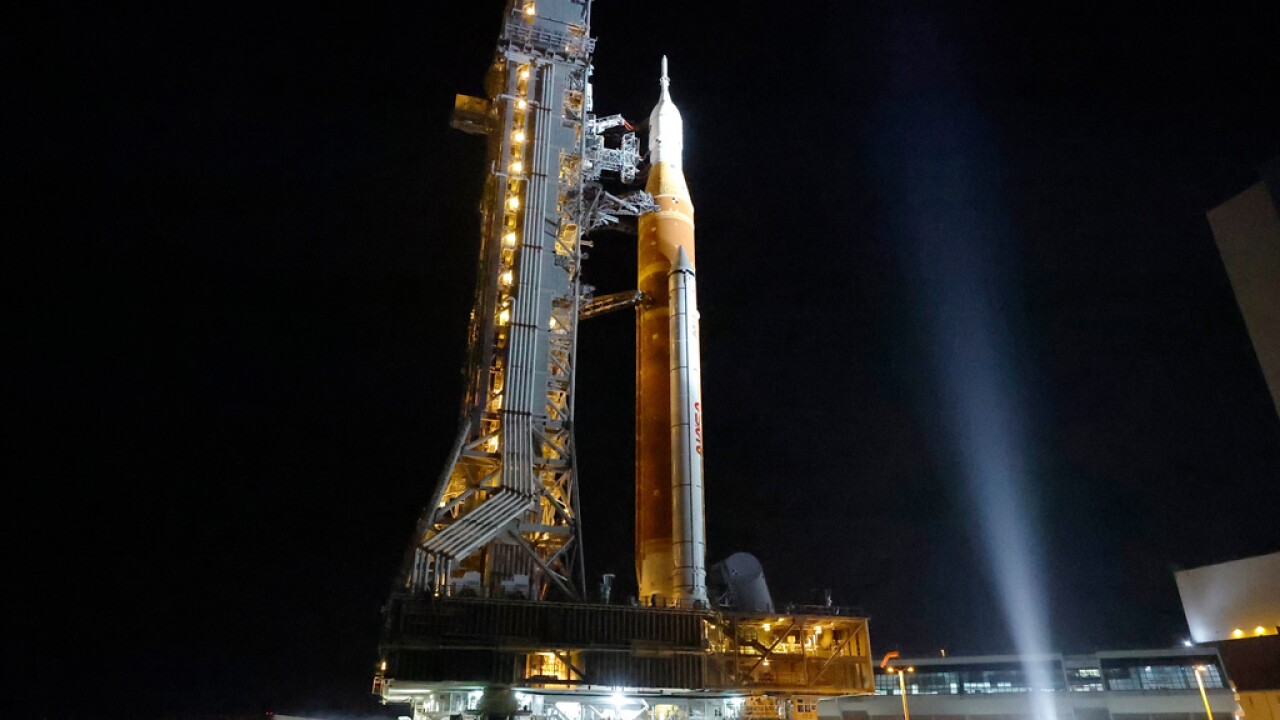


The journey to return humans to the moon could begin within hours as NASA prepares for the launch of Artemis II, with liftoff possible Wednesday evening.
NASA’s Artemis II Space Launch System rocket and Orion spacecraft sit on the launch pad at Kennedy Space Center in Florida as NASA astronauts Reid Wiseman, Victor Glover and Christina Koch, along with Canadian Space Agency astronaut Jeremy Hansen, remain in isolation before the mission.
Artemis II is the second of four planned missions to the moon.
Artemis I, launched in 2022, was the first mission in NASA’s Artemis program, which aims for deep space exploration beyond the moon. While Artemis I was uncrewed, Artemis II will carry four astronauts on a lunar flyby.
The last time NASA sent astronauts to the moon was Apollo 17 in 1972.
RELATED STORY | Artemis II nears launch after delays; astronauts start preflight isolation
The mission has several key objectives, according to Lakiesha Hawkins, acting deputy associate administrator for NASA’s Exploration Systems Development Mission Directorate.
Those include testing spacecraft systems and life-support capabilities in a crewed environment, assessing astronauts’ ability to maneuver the spacecraft, and conducting rendezvous and docking demonstrations to prepare for future lunar landings.
“We are going to set them on a course around the moon, slingshot them behind the moon and then back to safely land off the coast of San Diego in the Pacific Ocean,” Hawkins said. “It’s about a 10-day mission, and we are looking to open up the door to the age of Artemis.”
Once in space, Hawkins said the spacecraft will need to achieve a stable Earth orbit 24 hours after launch. The spacecraft will then perform a burn using its propulsion system and the moon’s gravity for assistance.
As it travels behind the moon, Earth will briefly lose contact with the crew during a short communications blackout.
“This crew will be going farther than any human has ever been away from Earth,” Hawkins said. “They’ll be about 250,000 miles away from their homes and friends. When they get on the backside of the moon, there will be a perspective that no human eye has ever seen before.”
After the lunar slingshot, NASA will position the spacecraft for splashdown off the California coast.
Ultimately, this mission is intended to help NASA maintain a deeper presence in space. While the International Space Station allows NASA to keep a permanent presence in low Earth orbit, the moon’s distance pales in comparison.
“We are focusing right now on proving out the systems and capability and how humans react off the Earth for a sustained period of time,” Hawkins said. “What we learn by establishing habitation, building systems from the regolith, and harnessing lunar ice from the surface will set us up to create fuel and prove our capabilities so that we can go deeper into space— to bodies like Mars and to places beyond.”
The forecast for Wednesday’s launch looks promising, with temperatures in the 70s and clearing skies.
RELATED STORY | NASA announces ambitious plans for a space station on the moon
