

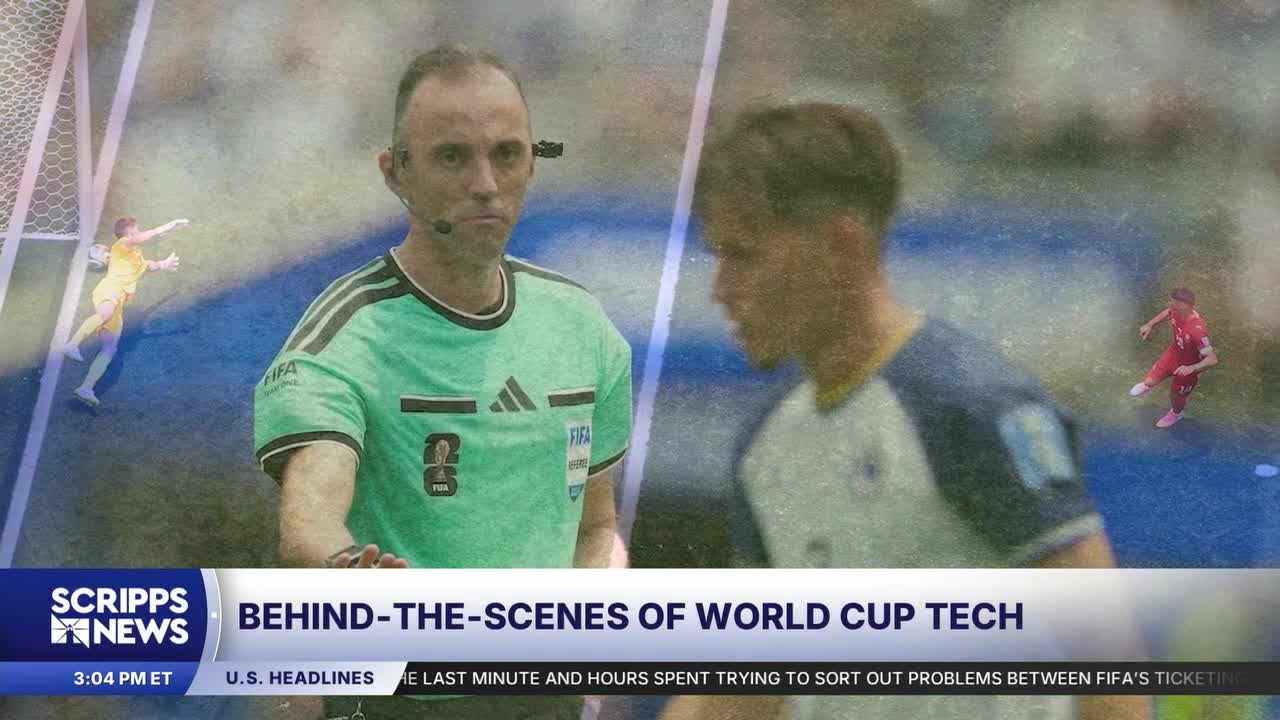


The excitement of the World Cup's matches provides the heartbeat of the tournament, but the brains of the games can be found in Dallas.
"This FIFA World Cup is the largest, most complex, most connected technology advanced World Cup ever," according to Abraham Arencibia, the Vice President of Technology Development at Verizon.
His team helped create the International Broadcast Center that stretches across 500,000 square feet of a downtown convention center. The facility is packed with a massive array of monitors, servers, switchers, and wires.
"We've deployed 80,000 miles of fiber, which is carrying all this massive data just to power this World Cup,” Arencibia says. “80,000 miles of fiber, We did a little bit of math. You can go around the world 3.2 times."
RELATED STORY | World Cup referee Omar Artan will receive full fee from FIFA despite being denied entry to the US
The hub manages routing for all live broadcasts — 104 games, in 16 host cities, across three countries. There are 45 to 50 cameras at each match, but not all of them are focused on the games. Some monitor out-of-bounds, offsides, and goal lines as part of Video Assistant Referee operations, alerting officials during real-time game situations and at times leading to overturned calls.
Other cameras provide 9,000 hours of online content around the clock. Camille Julien-Moraud, one of the Senior Communications Managers at the facility, says “In the space of a month and a half, we produce one year worth of content.”
Other innovations include game balls equipped with motion sensors transmitting positional data 500 times per second, digital player modeling for simulations and visual recreations, and integrated AI supporting analytics and behind-the-scenes workflows. Even the security dogs on site are robots.
This World Cup is serving as a working model for the high-tech future of global sports.
