
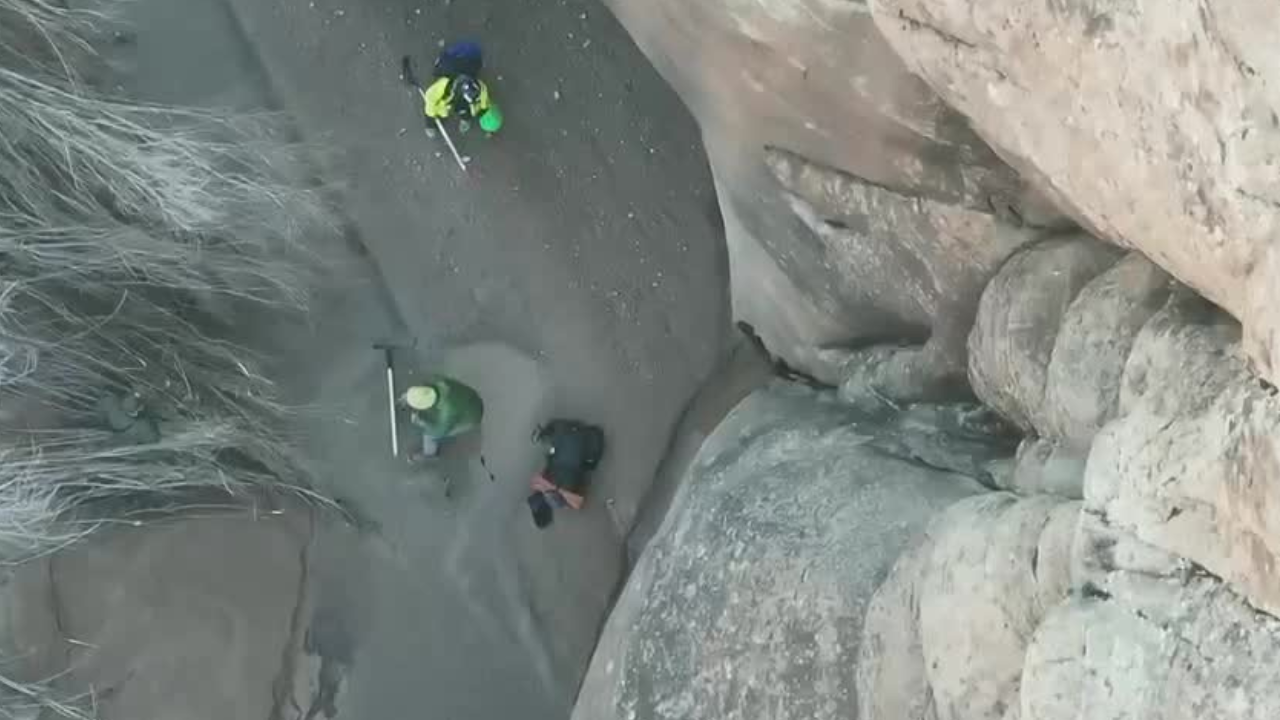


A seasoned hiker's worst nightmare became reality Sunday morning when he found himself trapped knee-deep in quicksand during a solo trek through Arches National Park.
"Before this trip, I honestly thought quicksand was more of a folklore or a legend," Austin Dirks said.
The experienced desert hiker, who has logged thousands of miles on trails, was navigating the upper end of Courthouse Wash around an hour before sunrise when his left leg broke through what appeared to be solid ground.
"I was able to pull it out, and then I shifted all my weight to my right foot. And I sunk up to the knee," Dirks said. "It felt like I had stepped into concrete, and then it hardened around my leg. I couldn't even move it a millimeter."
RAW RESCUE: Hiker trapped in real-life quicksand at Arches National Park in Utah
Contrary to cartoon depictions, Dirks discovered that the reality of quicksand differs dramatically from Hollywood portrayals.
"How it's depicted on TV is nothing like it is in real life," he explained. "The human body is more buoyant than the quicksand, so you'll never sink to above your head."
Real quicksand is more like thick, slimy mud than a sand trap. While online hiking experts often recommend leaning back to distribute weight, Dirks faced an additional threat: hypothermia in the slot canyon's frigid conditions with temperatures in the 20s.
"It's cold at night, and to spend it in cold water for a long period of time, that has serious consequences," said Scott Sollee with Grand County Search and Rescue.
WATCH: Police footage shows dramatic search and rescue in New Mexico floods
Quicksand rescues are extremely rare, according to Sollee, although hiker rescues represent their most common calls. He recalls only one other quicksand incident — a woman trapped for 13 hours in July 2014 on the same trail.
Jacob Paul, with the Washington County Search and Rescue team, told the Scripps News Group station in Salt Lake City that he doesn’t recollect ever dealing with a quicksand rescue there.
Dirks endured a two-hour ordeal stuck at a 45-degree angle, which he compared to bending forward in a ski boot. His preparation proved crucial: a GPS satellite messenger allowed him to alert authorities with his exact location.
"I realized that that's the closest I've ever come to dying. I owe them my life," he said.
The rescue highlighted the importance of proper emergency communication devices. Sollee emphasized that hikers should use their satellite devices immediately rather than attempting to relocate for cell service.
"We've had some people have those in-reach devices and not use them, and then go somewhere to call 911 and then leave that area. If you need to call 911, hit the SOS button on your satellite device if you have it, because that will tell us exactly where you're at," Sollee said.
Both Sollee and Dirks noted the rarity of such incidents makes prevention advice limited, though they recommend awareness when traversing areas with visible ground moisture.
The best preparation involves having backup plans, hiking with companions, informing others of your route, and carrying location devices for emergencies.
This story was originally published by Chris Reed with the Scripps News Group in Salt Lake City.
