

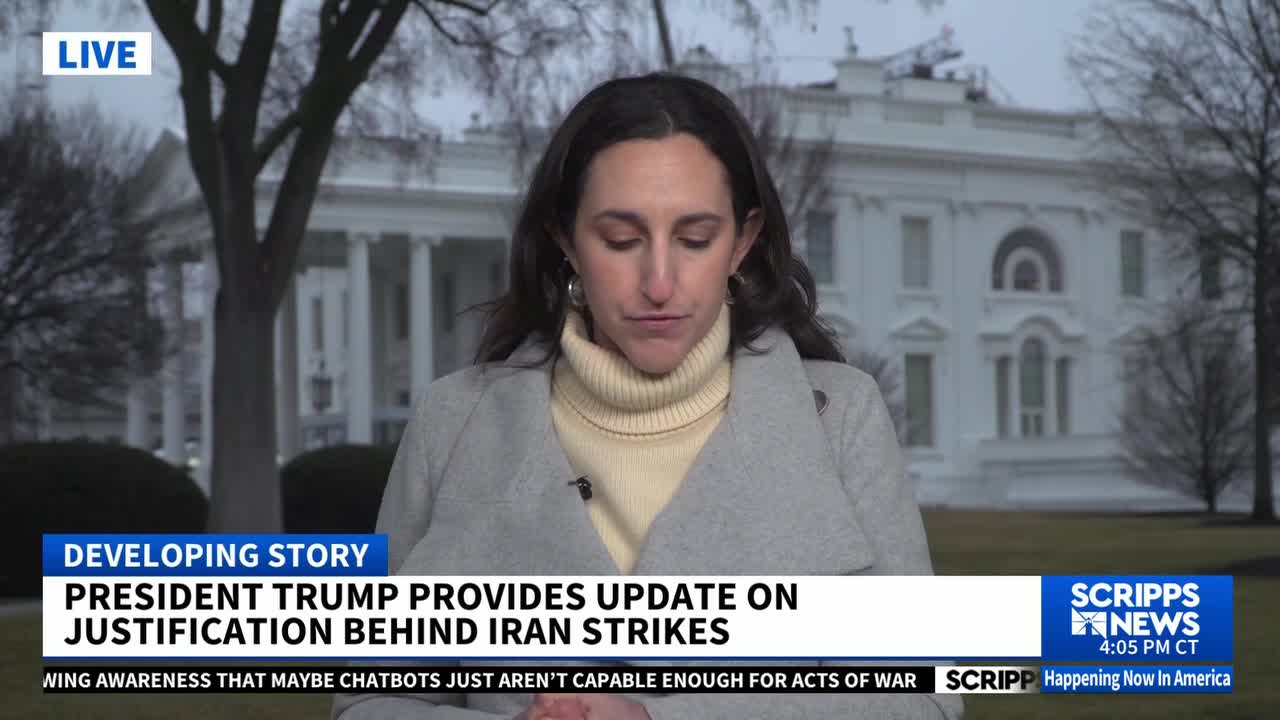


President Trump said he believed Iran was going to attack first as the White House continued to defend its reasoning for launching major combat operations against Iran.
The military continued strikes Tuesday with an objective the administration has described as eliminating Iran’s ballistic missile capabilities, navy and its ability to obtain a nuclear weapon.
“They were going to attack if we didn't do it, they were going to attack first. I felt strongly about that. And we have great negotiators, great people, people that do this very successfully and have done it all their lives, very successful. And based on the way the negotiation was going, I think they were going to attack first, and I didn't want that to happen,” Trump told reporters during a bilateral meeting with Germany’s chancellor.
“If anything I might have forced Israel's hand, but Israel was ready and we were ready. And we've had a very, very powerful impact because virtually everything they have has been knocked out now,” Trump added.
MORE ON IRAN | War effects spread through the Middle East as Iran retaliates
While military build up in the region and diplomatic efforts with Iran were pursued over the preceding weeks, Friday Trump declared they were “not exactly happy with the way they negotiated.” Hours later, major American and Israeli combat operations commenced, striking Iranian military targets and taking out its supreme leader and dozens of officials, as Iran has fired ballistic missiles and drones across the Middle East region.
“Our objective is to defend the American people by eliminating eminent threats from the Iranian regime, a vicious group of very hard, terrible people. Its menacing activities directly endanger the United States, our troops, our bases overseas, and our allies throughout the world,” Trump declared in a recorded video Saturday.
In the following days, administration officials pointed to Iran’s ballistic missile program and nuclear ambitions.
Secretary of State Marco Rubio described the operation “to eliminate the threat of Iran’s short-range ballistic missiles and the threat posed by their navy.” He explained the timing as a belief Iran would respond against an attack by anyone against the United States and there would be higher casualties if the United States waited for Iran to attack first.
“We knew that there was going to be an Israeli action, we knew that that would precipitate an attack against American forces, and we knew that if we didn’t preemptively go after them before they launched those attacks, we would suffer higher casualties and perhaps even higher those killed, and then we would all be here answering questions about why we knew that and didn’t act,” Rubio told reporters Monday.
When pressed further, Rubio further explained Tuesday, “The President made a decision, and the decision he made was that Iran was not going to be allowed to hide behind its ballistic missile program, that Iran was not going to be allowed behind its ability to conduct these attacks. That decision had been made. The President systemically, made a decision to systematically destroy this terroristic capability that they had, and we carried that out. I was very clear in that answer. This was a question of timing, of why this had to happen as a joint operation, not the question of the intent. Once the President made a decision that negotiations were not going to work, that they were playing us on the negotiations, and that this was a threat that was untenable, the decision was made to strike them.”
Trump decided to strike at this time to “precipitate an attack on American forces” and because the administration believes “this is the weakest Iran has ever been,” according to an administration official, who noted Trump’s explanation that it was the “last, best time” to destroy Iran’s capabilities to produce nuclear weapons, launch ballistic missiles or arm terrorist proxies, explaining “all can be true at once.”
GETTING OUT OF IRAN | Anxious travelers scramble as Iran war strands tens of thousands across the Middle East
Inside negotiations with Iran
Senior Trump administration officials, speaking on the condition of anonymity, further revealed more details about negotiations with Iran, which ultimately led them to believe that Iran was trying to buy time “to preserve whatever they could to get past the term of President Trump in order to get to a nuclear weapon.”
The US’s objectives were prohibiting the acquisition of a nuclear weapon, including retrieving material from the Iranians and permanently shuttering the facilities hit in Operation Midnight Hammer, while the region could discuss Iran’s ballistic missile program and support for proxy groups like the Houthis, Hezbollah and Hamas, according to the officials.
The officials took note of provocative statements, the offerings the Iranians did not take the US up on and concerns over an Iranian proposal, they believed “was all a subterfuge” and compared to “Swiss cheese.”
The officials also noted the United States offered Iran free nuclear fuel at no cost for a civil program, the lifting of some sanctions and the US as an investor on some projects if there was a new framework, according to the officials, but the Iranians declined the offer of free fuel and wouldn’t move facilities above ground.
The sense after receiving Iran’s proposal was dismay, as officials said it would allow Iran to enrich at 5 times the level allowed under the JCPOA, though the United State’s redline was no enrichment.
The Iranian proposal included a build out schedule with an amount of enrichment needed for new projects starting at 20 percent enrichment, according to officials, who suggested a research facility purported to be used for civil purposes was a false pretense to hide stockpiling. Iran had 460 kilograms of 60 percent enriched uranium and 1000 kg at 20 percent, according to the officials, who noted it could take as little as a week to get 60 percent to 90 percent weapons grade enrichment.
The Director General of the International Atomic Energy Agency, who was involved in the US-Iranian negotiations, told CNN, “We never had information indicating that there was a structured, systematic program to build to construct a nuclear weapon, so we have to balance the two things. Yes, many reasons for concern, but there wasn't to be a bomb tomorrow or the day after tomorrow.”
“I have been very clear and consistent in my reports on Iran’s nuclear programme: while there has been no evidence of Iran building a nuclear bomb, its large stockpile of near-weapons grade enriched uranium and refusal to grant my inspectors full access are cause for serious concern. For these reasons, my previous reports indicate that unless and until Iran assists the (IAEA) in resolving the outstanding safeguards issues, the Agency will not be in a position to provide assurance that Iran’s nuclear programme is exclusively peaceful,” he later stated online.
Amidst the progression of statements from the Trump administration, some believe the administration is correct.
“Underlying all of the confusing and contradictory statements that the administration has done, and I've seldom seen a worse rollout of a major military campaign, their underlying point is correct,” said Ambassador James Jeffrey, a distinguished fellow at The Washington Institute who has held a number of diplomatic posts including with focuses on Iran. “Strategically, Iran showed, if they hadn't showed it in the 20 years before 2023 with a million people killed in Iraq, Yemen and Syria, they showed from 2023 to 2025 that they are a volatile, aggressive threat to the entire region. And as Kissinger said, they have to decide whether they are a cause, which is where they really are, rather are a nation which they pretend to be only to get diplomatic treatment. And despite their defeat in 2025, it was obvious to everybody that they were trying to crawl back out of their hole, out of their rubble, figure out how, despite being more or less obliterated, they could restart in nuclear program.”
The potential for regime change
Meanwhile, while the administration has not listed regime change as an objective in its operations, Trump has called for Iranians to “seize this moment.”
President Trump said the worst case would be “we do this and then somebody takes over who’s as bad as the previous person”
“We’d like to see somebody in there that's going to bring it back for the people. And we'll see what happens with the people. You know, they have their chance and we've said don't do it yet. If you're going to go out and protest don't do it yet. It's very dangerous out there. A lot of bombs are being dropped,” Trump said.
The president acknowledged that “most of the people we had in mind are dead.”
When asked if exile crown prince Reza Pahlaviis was an option, Trump said “I guess he is.” But added, “Some people like him and we haven't been thinking about, too much about that. It would seem to me that somebody from within might, maybe would be more appropriate, I've said that. He looks like a very nice person, but it would seem to me that somebody that's there that's currently popular, if there's such a person.”
However, the administration is working on what a sanctions relief package could be if a framework is agreed to with a new government that meets the standards the US has laid out, officials explained.
Previously, Trump “said new potential leadership in Iran has indicated they want to talk and eventually he will talk. For now, Operation Epic Fury continues unabated,” according to a senior White House official.
Ali Larijani, the head of Iran’s supreme national security council, proclaimed on X that Iran won’t negotiate with the US.
Notably, Steve Witkoff has not had conversations with Ali Larijani, the head of Iran’s supreme national security council, nor Iran’s foreign minister since operations started, according to senior Trump administration officials, and there has not been the use of an interlocutor.
“It's clear that at least conceptually, the administration is okay with the concept of regime change, but not regime change of the George W Bush era variety, right? We're not talking about Iraq. We're not talking about Afghanistan,” said Ilan Berman, Senior Vice President of the American Foreign Policy Council.
People watching the region point to a lack of unification though.
Berman pointed to unsatisfactory results in Trump’s first term in efforts to get Iranian opposition groups in the diaspora to work together.
“They couldn't get these guys to sit at a table, they couldn't get these guys to form a durable coalition. So I think both, both of those factors are being sort of, you know, are part of the mix or part of the administration's consideration. And so they're not thinking about Iraq, they're not thinking about Afghanistan, but they're thinking, I think, much more along the lines of Venezuela,” Berman said.
The protest movement and regime opponents are “notoriously not unified,” according to a former defense official, who said a best case scenario would be to see leadership that is pro American, with no interest in militarizing Iran, but cautioned it was too early.
“To my knowledge, there is currently no fully developed strategy for the future civilian leadership of Iran,” German Chancellor Friedrich Merz told reporters after his meeting with Trump.
Administration works to help stranded Americans escape escalating conflict
As the Trump administration worked to justify the Iran war campaign to the American people, officials soon faced a new problem: how to evacuate the tens of thousands of U.S. citizens already in the region as the conflict was escalating.
The U.S. State Department had issued travel advisories urging Americans to reschedule or avoid travel altogether to nations including Israel, Lebanon, Syria, Jordan, Iraq, Afghanistan, the United Arab Emirates and Iran. Further advisories urged Americans elsewhere in the region — including in Oman, Saudi Arabia and Egypt — to exercise “increased caution” due to greater security risks from possible retaliation by Iran and its proxies.
But for those Americans already present in those countries, returning to the U.S. on their own was near-impossible; most commercial flights from the region have been canceled or suspended in light of the conflict, and commercial airspace remains closed altogether in some jurisdictions.
Early Tuesday morning, U.S. Ambassador to Israel Mike Huckabee noted there are “VERY LIMITED options” for Americans in Israel seeking to return to the U.S. He advised citizens utilize shuttle buses organized by Israel’s Ministry of Tourism to travel Cairo, Egypt, and then try to return to the U.S. on commercial flights.
“Not sure when Ben Gurion Airport in Tel Aviv will reopen,” Huckabee wrote. “Hopefully soon, but even when it does, there will be VERY limited flights with priorities to those who already were ticketed.”
Yet as public scrutiny of the situation intensified, the State Department ramped up efforts.
As of Tuesday evening, more than 9,000 U.S. citizens have returned to the U.S. from the Middle East, a State Department official told Scripps News, including more than 300 from Israel. The Department is directly facilitating charter flights for U.S. citizens stranded in the UAE, Saudi Arabia and Jordan, and working to facilitate travel for those trapped in places lacking commercial aviation availability to third countries where outbound flights are still possible.
Americans currently in the region and needing assistance are urged to call the State Department’s 24/7 hotline, (202) 501-4444, staffed by more than 120 officials. U.S. officials have already been in touch with more than 3,000 citizens in the region, officials said.
Moreover, the U.S. would waive the statutory requirement requiring Americans to reimburse the government for any travel federal officials arrange.
"They do not need to pay," Tommy Pigott, deputy spokesperson for the State Department told Scripps News. "We are actively helping Americans, proactively reaching out to Americans."
On the domestic front, the State Department was working to brief congressional staff providing consular support for Americans abroad, as well as U.S. governors with citizens trapped overseas. On Tuesday, staff began making proactive calls directly to Americans who’d requested support returning to the U.S.
But asked Tuesday afternoon about the plight of Americans unable to return home and why the U.S. appeared to lack a more fulsome evacuation plan, President Trump brushed aside such concerns, suggesting the speed of the operation prohibited implementing such measures.
“It happened all very quickly,” Trump told reporters. “I thought we were going to have a situation where we were going to be attacked.”
