

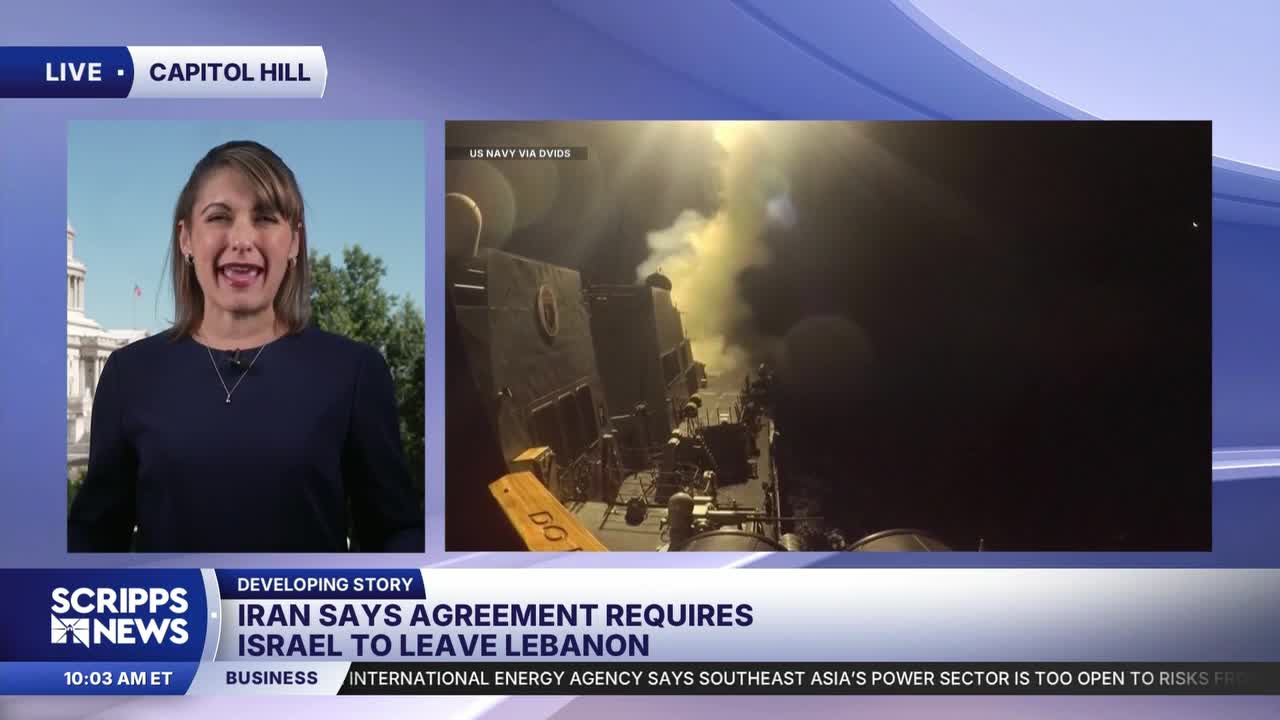


President Donald Trump is using the G7 summit in France to sell fellow world leaders on his proposed agreement with Iran, even as conflicting accounts from U.S. and Iranian officials leave key details of the deal in question.
Trump said he is open to sending the agreement to Congress for review. G7 leaders are meeting today and tomorrow and are expected to discuss Russia's war in Ukraine in addition to the crisis in the Middle East.
RELATED STORY | Trump announces agreement aimed at ending war with Iran
Trump spoke to the media following a meeting with the emir of Qatar, saying he had a productive meeting with Ukrainian President Volodymyr Zelenskyy and that he plans to speak with him again. Trump also said Russia should make a deal with Ukraine.
What Trump says is in the Iran deal
Trump expressed confidence in the proposed agreement and said preventing Iran from obtaining a nuclear weapon was a central reason he pursued it.
"The biggest thing is they will not have a nuclear weapon and that's the reason I got in and that's the reason I agreed to sign," Trump said. "We originally had — Marco was with me — and they originally wrote that we will not develop a nuclear weapon. I said no, no, you're not going to develop but you're not going to buy either. So we have that, took another couple of days of time. Everything was ridiculous, but so we have they will not develop, purchase, buy or any other thing. They're not going to acquire a nuclear weapon. If they do, all hell will rain down on them, and they're not going to do that, you know."
Senior administration officials have said the deal is structured so Iran must uphold its end of the bargain before receiving any benefits, such as sanctions relief or the return of frozen Iranian assets. Trump also said repeatedly that the U.S. is not compensating Iran in any way and is not paying for reconstruction of the country — a claim that contradicts what Iranian officials have reported.
Conflicting accounts cloud the deal's details
The public and the media have not seen the actual text of the proposed agreement. Because the U.S. and Iran are offering different versions of what was agreed to, it remains unclear exactly what the deal contains.
One significant point of contention involves Israel and Lebanon. Iran's top diplomat has said the agreement requires Israel to pull its forces out of Lebanon. Israel, which was not a party to the negotiations and is not a signatory to the deal, says it will stay as long as it wants.
Israel may have helped launch the war alongside the U.S. in February, but it has not been part of the peace negotiations. It is unclear how an agreement between the U.S. and Iran could compel Israel to withdraw troops from Lebanon — something Iran says is a requirement but Israel has flatly rejected. Whether the dispute over Israel, Lebanon, and continued Hezbollah attacks could put the deal in jeopardy remains an open question.
Economic ripple effects could take time
Markets have reacted positively to news of a potential peace deal, and oil prices have dropped — both seen as encouraging signs. But those movements are based on anticipation, not confirmed details.
The Strait of Hormuz has not reopened to its previous capacity, and doing so is likely to take time. Hundreds of ships have been backed up in the Persian Gulf waiting to pass through the strait. Working through that backlog will take time, as will ramping up oil production. Some Middle East oil companies paused, slowed down, or stopped production entirely during the conflict, since there was little point in extracting oil that could not be shipped to international markets.
Ship captains will also need confidence that any peace deal will hold and that passage through the strait will be safe. Concerns remain about mines that may have been placed in the waterway, and the possibility of lingering risks even under a peace agreement. A ceasefire has been in place since the beginning of April, but the region has not been entirely free of attacks since then.
RELATED STORY | Trump says the 100-day-old Iran war doesn't betray his 'no new wars' campaign promise
The new 60-day peace deal may remain in a fragile and tenuous state as both sides work to build trust and demonstrate they will uphold their commitments. Greater confidence in the deal — and a return to normal conditions in the Middle East, the Strait of Hormuz, and global energy markets — will likely depend on both sides following through.
