

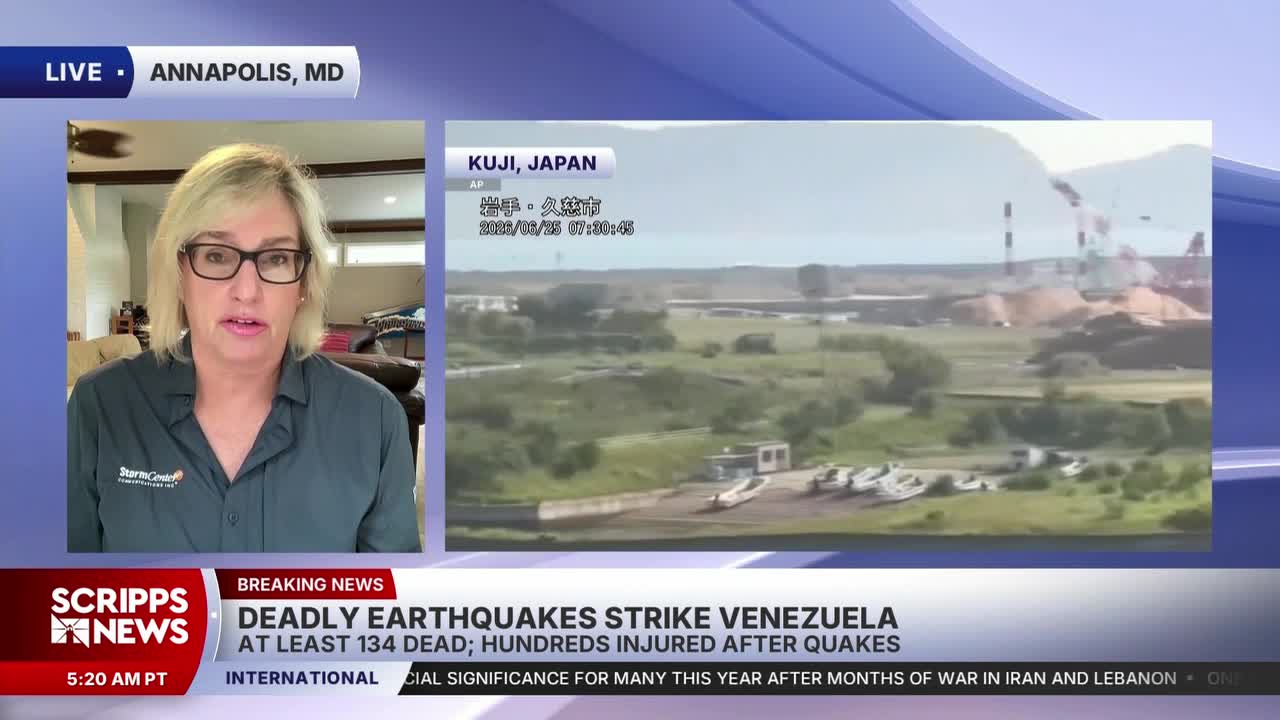


Back-to-back earthquakes struck Venezuela on Thursday, killing more than 150 people and toppling buildings in the capital of Caracas.
RELATED STORY | At least 164 dead and 971 injured after powerful quakes rock Venezuela, acting president says
Venezuela sits near multiple fault lines, making the region prone to seismic activity. Dr. Ellen Prager, author and chief scientist at StormCenter Communications, said the back-to-back earthquakes are not uncommon for this part of the world
"This is an area that, in fact, seismologist Robert Yeats called an earthquake timebomb," Prager said. "We've known for many years that it's at high risk because of the tectonic setting of larger earthquakes. In fact, in 1812 there was a 7.7 magnitude earthquake that killed 500 people. But of course, now millions more people live [there], which makes it a really dangerous place. So it's not uncommon to have large earthquakes in this area."
IN CASE YOU MISSED IT | A powerful 7.2 magnitude earthquake strikes off northern Japan. No tsunami warning is triggered
While the earthquakes hit close to Venezuela's coastline, they did not prompt an immediate tsunami warning. Prager explained that is because of the type of fault movement involved.
"It was a strike-slip fault, which means you basically have the tectonic plates sliding past one another. There isn't typically vertical motion, which is what you need underwater to create a tsunami," Prager said. "But the risk remains in that there could've been a submarine landslide, which would displace water, which could create a tsunami. But in a typical strike-slip fault kind of motion, you don't tend to trigger this nominee because, again, you need that vertical motion or displacement underwater."
Watch our full interview with Dr. Ellen Prager, author and chief scientist at StormCenter Communications, in the video player above.
