

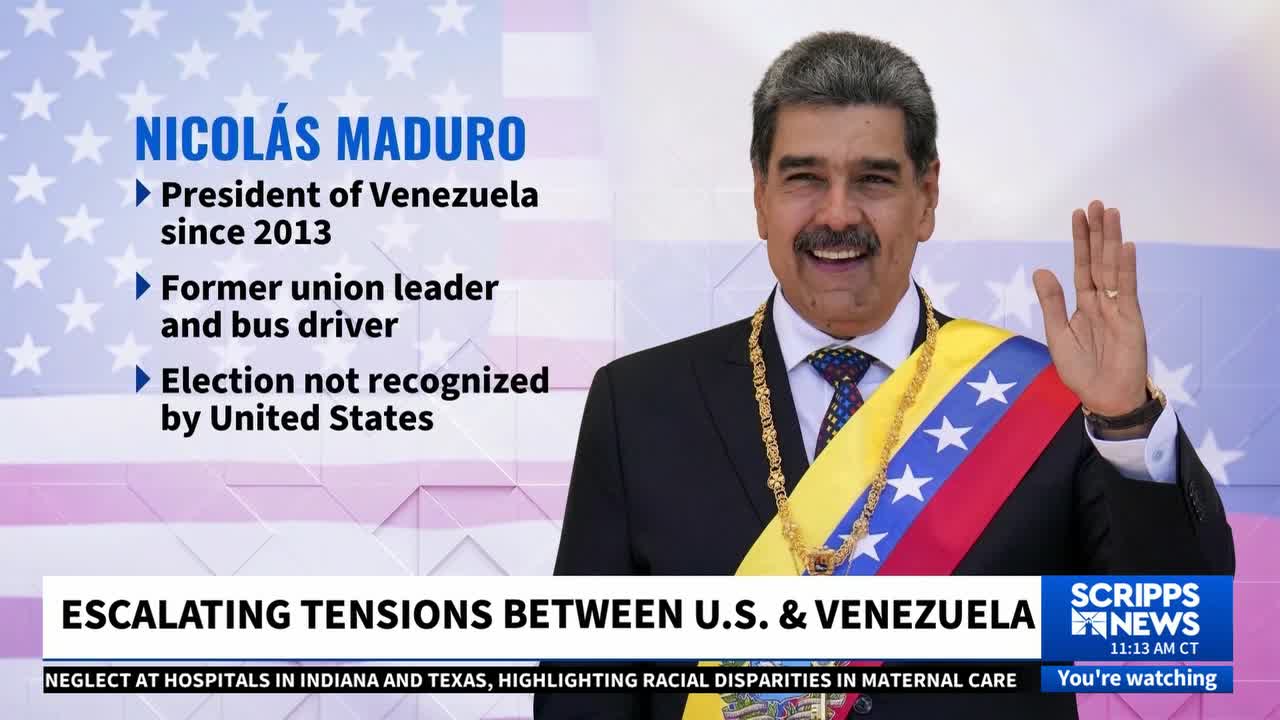


With thousands of American service members now stationed in the Caribbean, many are asking what is driving the growing tension between the United States and Venezuela.
President Donald Trump has ordered airspace around Venezuela closed and said Tuesday that land strikes on countries producing illegal narcotics could begin soon. Trump recently spoke with Venezuelan President Nicolás Maduro but has released few details about the call.
Tensions Rising
The Navy’s most advanced aircraft carrier, the USS Ford, remains positioned in the Caribbean. Nearly 15,000 sailors and Marines are stationed in the region — the largest presence there in generations.
In Washington, the White House recently designated top Venezuelan officials as members of a foreign terrorist organization for alleged ties to the drug trade. The Pentagon says it has carried out 21 strikes on boats in recent months, killing 82 people.
RELATED STORY | Hegseth defends double boat strike as Trump says operations could extend to land
Much of the current strain centers on Maduro, 63, who has led Venezuela since 2013. A former union leader and bus driver, he succeeded Hugo Chávez, whose presidency from 1999 until his death in 2013 marked a deep deterioration in U.S.-Venezuelan relations. The United States does not recognize Maduro’s most recent election, citing fraud allegations.
Historical Tension
Chávez frequently blamed the United States for the country’s economic and political problems, a strategy Maduro has continued.
“Victory forever,” Maduro declared at a recent rally.
“We consider Venezuela to be not a very friendly country,” President Trump told reporters over the weekend.
The rocky relationship between the two nations has a long history. In 2002, Chávez accused the Bush administration of orchestrating an attempted coup. In 2015, President Barack Obama imposed sanctions on Venezuela over human rights abuses. In 2018, the Trump administration labeled Maduro’s re-election that year a “sham.” And in 2025, shortly before leaving office, President Joe Biden offered a $25 million reward for Maduro’s arrest.
RELATED STORY | Trump confirms the CIA is conducting covert operations inside Venezuela
"The Maduro administration radicalized very quickly," said Javier Corrales, a Venezuela politics expert at Amherst College.
Corrales said Maduro’s economic policies and lack of fair elections have contributed to mass migration and the expansion of the country’s illegal drug trade, problems that have frustrated President Trump. Venezuela has also deepened ties with China by selling Venezuelan oil.
“Maduro's hyper radicalization involved becoming a mean dictator, incredibly oppressive. Also, a government destroying the private sector,” Corrales said. “By all accounts, he is an incredibly unpopular president.”
What Comes Next
Any U.S. land strike on Venezuela — or any significant effort to remove Maduro — would represent a major escalation. Corrales cautions that while the U.S. military is far more capable, Venezuela’s armed forces are among the largest in the Americas.
“The Trump administration could be blind to all the things that could go wrong here,” Corrales said.
He added, “It's not automatic that getting rid of a ponzi scheme could generate a reset that will bring order and stability.”
